
Start With a Clear Foundation: Website + Conversion Setup
Before investing in traffic, your website needs to be built for conversion.
A modern small business website is more than just a digital brochure. It should guide visitors toward a clear action, whether that’s booking a call, submitting a form, or making a purchase.
At a minimum, your site should include:
- Clear service positioning above the fold
- Strong call to action buttons
- Fast load speed (under 3 seconds)
- Mobile optimization
Equally important is tracking. Without proper conversion tracking, you won’t know which campaigns are working.
This includes setting up:
- Google Analytics
- Conversion events (calls, forms, purchases)
- CRM integration to track leads through the pipeline
This is where many businesses fall short. They drive traffic without having the infrastructure to convert or measure it.
Search Engine Visibility: SEO Still Drives Long-Term Growth
Search engine optimization remains one of the highest ROI channels for small businesses.
When done correctly, SEO brings in consistent, high intent traffic without ongoing ad spend.
In 2026, the focus has shifted toward:
- Local SEO (Google Business Profile optimization)
- High quality, intent-driven content
- Technical performance (site speed, indexing, structure)
Small businesses should prioritize ranking for service + location keywords, such as “dentist in Toronto” or “roof repair near me.”
Unlike paid ads, SEO takes time, but it compounds. A well-optimized site can generate leads for months or years with minimal additional investment.
Paid Advertising: Fastest Way to Generate Leads
While SEO builds long term visibility, paid advertising delivers immediate results.
Platforms like Google Ads and Meta (Facebook/Instagram) remain essential for small businesses that want predictable lead flow.
The key is understanding how to allocate your budget.
A practical starting point for most small businesses looks like this:
| Channel | Budget Allocation |
| Google Ads | 50% |
| Facebook/Instagram Ads | 30% |
| Retargeting | 20% |
Google Ads should capture high intent searches, while Facebook Ads builds awareness and generates new demand. Retargeting ensures you stay in front of potential customers who didn’t convert the first time. The mistake most businesses make is treating ads as a one time effort instead of a system that needs continuous optimization.
CRM and Lead Management: Where Revenue Is Actually Made
Driving leads is only half the equation. Converting those leads into customers is where real growth happens. This is why having a CRM system is no longer optional.
A properly set up CRM allows you to:
- Track every lead from source to sale
- Automate follow-ups via email or SMS
- Reduce missed opportunities
- Improve close rates
Many small businesses lose revenue simply because they respond too slowly or inconsistently to inquiries. In 2026, speed and consistency win. Businesses that follow up within minutes, not hours, see significantly higher conversion rates. CRM systems also give you visibility into which marketing channels are actually generating revenue, not just leads.
Content Marketing: Build Trust Before the Sale
Modern customers do research before making decisions. That means your business needs to show up with valuable content.
This includes:
- Blog posts answering common questions
- Service pages that clearly explain your offering
- Educational content that builds authority
Content marketing works especially well when combined with SEO. It allows you to rank for long tail keywords while positioning your business as a trusted expert. Over time, this reduces your reliance on paid ads and improves conversion rates across all channels.
Reputation and Reviews: Your Hidden Conversion Lever
Online reviews have become one of the most influential factors in purchasing decisions.
A strong review profile can dramatically increase conversion rates without increasing traffic.
Small businesses should actively:
- Request reviews from satisfied customers
- Respond to all reviews, positive and negative
- Maintain a consistent rating across platforms
Even a one star difference in rating can significantly impact customer trust. In competitive local markets, reviews often determine whether someone chooses your business or a competitor.
Email and Retention Marketing: The Overlooked Growth Channel
Most businesses focus heavily on acquiring new customers but neglect retention. Email marketing remains one of the highest ROI channels because it allows you to stay connected with existing customers at virtually no cost.
Simple strategies include:
- Follow up sequences after a lead inquiry
- Promotions for returning customers
- Educational newsletters
Retention is often cheaper than acquisition, and improving it even slightly can have a major impact on overall revenue.
Budget Allocation: A Practical Framework for 2026
One of the most common questions small business owners ask is how much to spend on marketing. A general guideline is allocating 7–12% of revenue toward marketing, depending on growth goals.
Here’s how that budget can be distributed:
| Area | % of Budget |
| Paid Ads | 40–50% |
| SEO & Content | 20–30% |
| CRM & Automation | 10–15% |
| Website Optimization | 10–15% |
The key is balance. Over investing in one channel while ignoring others often leads to inconsistent results.
Bringing It All Together
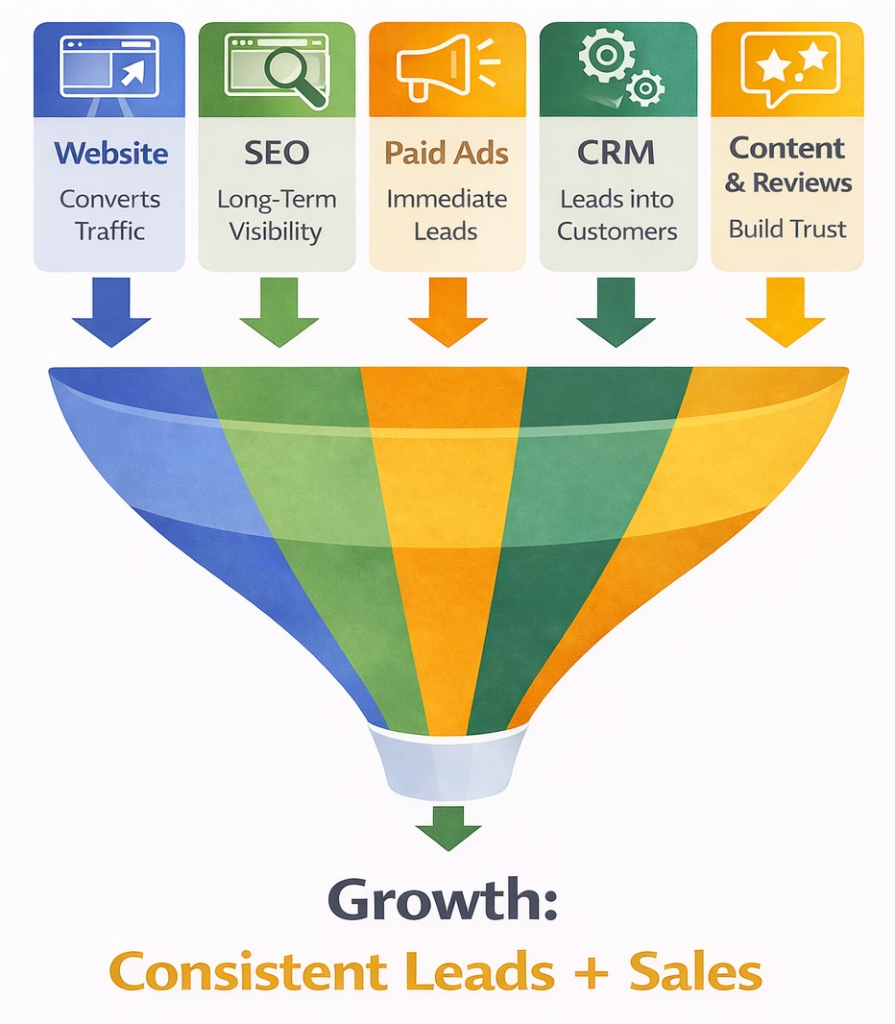
Digital marketing is not about isolated tactics, it’s about building a system.
When these elements work together, growth becomes predictable.
Want Help Building a System That Actually Works?
If you’re trying to manage all of this on your own, it can quickly become overwhelming.
At Canopy Media, we help small businesses build and manage complete digital marketing systems, from paid ads and SEO to CRM integration and conversion optimization.
If you’re ready to stop guessing and start scaling, explore our services or get in touch to see how we can help you grow more efficiently in 2026.
Conclusion
Knowing what to do is one thing, executing it correctly is what actually drives results. Most small businesses struggle not because they lack ideas, but because they don’t have a clear system tying everything together. That’s where the gap and the lost revenue happens.
At Canopy Media, we help small businesses implement complete digital marketing systems that generate consistent leads, improve conversion rates, and scale sustainably. From SEO and paid ads to CRM integration and automation, every part of your marketing works together, not in silos. If you’re ready to stop guessing and start growing with a strategy that’s built to perform in 2026, now is the time to take action.
