For your dental practice to survive and thrive, you need new patients, and this list of some tried and true best dental marketing ideas can help.
In 2026, growing a dental practice isn’t just about “doing marketing”, it’s about building a predictable system for acquiring new patients, understanding your numbers, and knowing what to expect in terms of dental marketing costs and ROI.
Why Dental Marketing Matters More Than Ever
Here’s an overview of high impact dental marketing strategies that combine SEO, paid advertising, and patient engagement to drive measurable results.
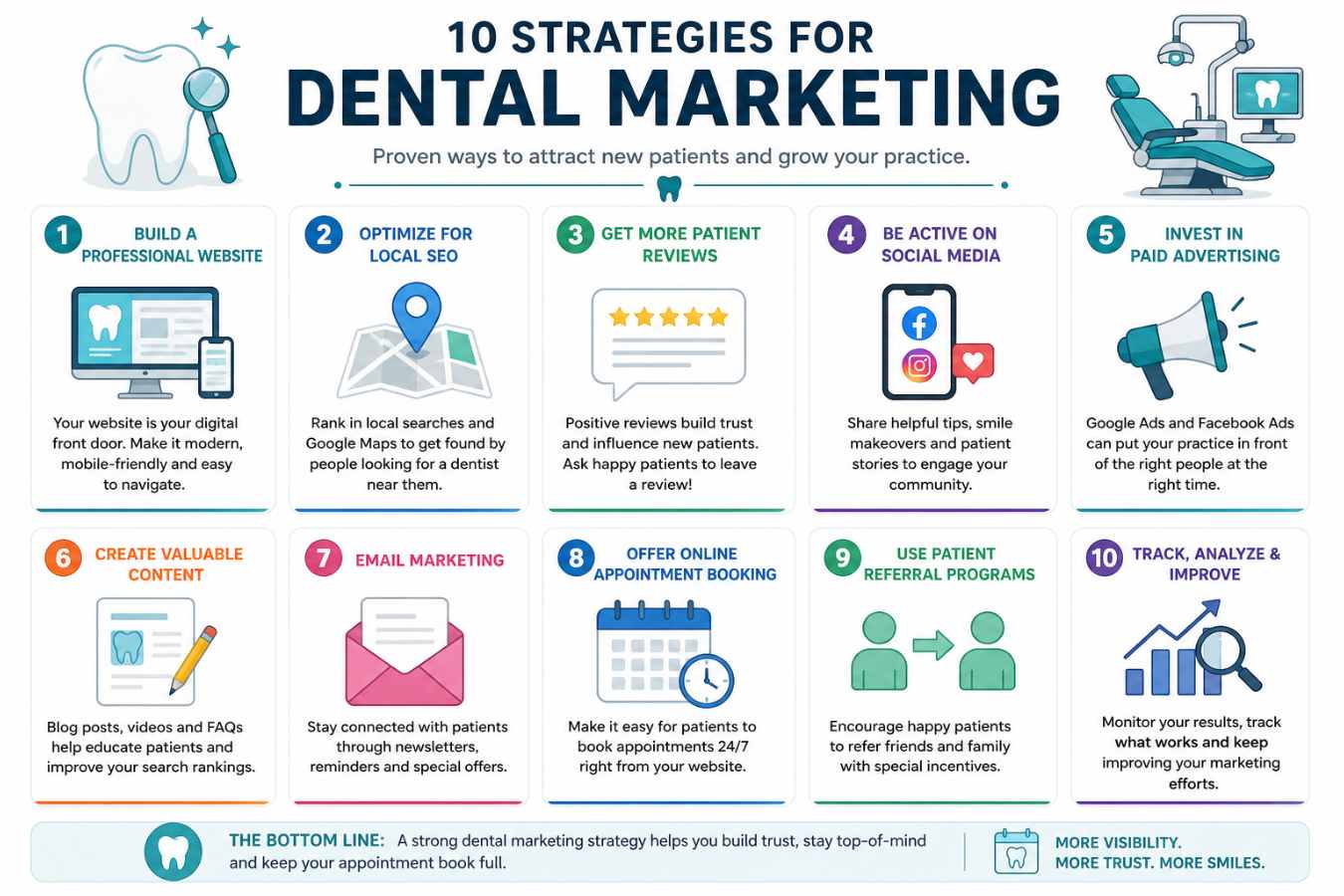
Lack of growth and low patient counts are one of the most common reasons dental practices struggle to scale.
Today, over 75% of patients research a dentist online before booking, and more than 60% will choose a competitor simply because they appear higher in search results or have stronger reviews.
At the same time, digital competition has increased across Google Ads, SEO, and local listings, making strategy far more important than simply “being online.”
#1 – A Website Designed for Conversions
Simply throwing up a few pages with your contact information isn’t going to turn visitors into patients.
Your website is still your #1 marketing asset, but it needs to function as a conversion engine, not just an online brochure.
Industry data shows that most dental websites convert between 2–4%, while optimized, conversion focused sites can reach 8–12% or higher.
What high converting dental websites include:
- Simple, fast online booking
- Clear service pages for high value treatments
- Mobile first design
- Strong trust signals, including reviews, before and after cases, and certifications
What practices can expect from different website types:
| Website Type | Typical Investment Range | Expected Outcome |
|---|---|---|
| Basic Website | Lower initial investment | Limited lead generation |
| Custom Optimized Site | Mid to high investment range | Higher conversion rates and lead quality |
| Growth Focused Website | Higher upfront investment | Faster ROI when paired with ads and SEO |
The key takeaway: your website directly impacts how much you pay per patient across all channels.
#2 – SEO (Search Engine Optimization)
Search engine optimization can be complex and includes many variables. But it is still one of the best ways to drive long-term organic traffic to your site. Read more.
SEO remains one of the highest ROI channels for dental practices, especially for long term growth and reducing dependency on paid ads.
Key SEO stats:
- Top 3 Google results capture over 50% of clicks
- “Dentist near me” searches continue to grow year over year
- Google Maps listings drive a majority of inbound calls for local practices
What practices should know about SEO costs:
| SEO Level | Typical Monthly Investment | Timeline |
|---|---|---|
| Basic Local SEO | Lower monthly range | 4–6 months |
| Growth Campaigns | Mid range industry investment | 3–5 months |
| Competitive Markets | Higher investment range | 6+ months |
Rather than focusing on cost alone, practices should evaluate SEO based on cost per patient over time, which often decreases as rankings improve.
#3 – Mobile Optimization is Non-Negotiable
In 2026, over 70% of dental searches happen on mobile devices, and mobile users are significantly more likely to convert quickly if the experience is seamless.
Mobile optimization is not just about having a responsive website. Patients should be able to find information, call your office, and book an appointment without frustration.
Must-haves include:
- Fast load times under 2.5 seconds
- Click to call functionality
- Easy navigation and booking
#4 – Google Ads (Paid Search)
Google Ads continues to be one of the fastest ways to generate new patients, particularly for high value services like implants, Invisalign, and cosmetic procedures.
Unlike SEO, which builds over time, paid search can start generating traffic almost immediately. The key is ensuring campaigns are built around the right services, locations, keywords, and landing pages.
What to expect from paid ads:
| Metric | Typical Range |
|---|---|
| Cost per Click | Varies significantly by service and location |
| Cost per Lead | Moderate to high depending on competition |
| Cost per Patient | Higher for cosmetic and implant services, lower for general dentistry |
Budget expectations by market type:
| Market Type | Typical Monthly Ad Spend |
|---|---|
| Smaller Markets | Lower range |
| Mid Sized Cities | Moderate investment range |
| Major Cities | Higher investment required due to competition |
The key advantage of paid ads is speed, but performance depends on strong tracking, landing pages, and ongoing optimization.
#5 – Track, Measure, and Optimize
If you have a goal in mind for your practice, you’re lost without measurement.
The biggest difference between growing practices and stagnant ones is data. Without clear tracking, it is difficult to know which channels are producing results and which ones are wasting budget.
Key metrics every practice should track:
- Cost per lead
- Cost per patient
- Call answer rate, since missed calls directly impact revenue
- Website conversion rate
- Patient lifetime value
Without these numbers, it’s impossible to scale efficiently.
#6 – Should You Hire a Marketing Partner?
Most high-growth dental practices work with marketing partners because of the increasing complexity across SEO, ads, tracking, and conversion optimization.
What practices typically compare:
| Option | General Cost Level | Considerations |
|---|---|---|
| In House | Higher fixed cost | Limited specialization |
| Freelancers | Lower cost | Inconsistent results |
| Agencies | Mid to higher investment | Full strategy, execution, and tracking |
What Does Dental Marketing Cost?
This is one of the most searched questions by dental practice owners, and the answer depends on your goals, competition, and market.
Industry wide, dental practices typically allocate a percentage of their revenue toward marketing rather than working from a fixed budget. Established practices often invest in the range of 5–10% of gross revenue to maintain steady growth, while newer or growth focused practices may allocate closer to 10–15%+ to increase visibility and capture market share.
These benchmarks vary depending on competition, location, and growth goals, but they provide a useful guideline when evaluating overall marketing investment.
While percentage based budgeting provides a high level guideline, it’s also important to understand how that investment is typically distributed across different marketing channels.
Industry wide benchmarks:
| Channel | Typical Investment Range |
|---|---|
| SEO | Ongoing monthly investment, varies by competition |
| Google Ads | Scalable based on goals and market size |
| Website | One time investment with long term ROI |
| Social Media Ads | Flexible budgets depending on strategy |
| CRM & Email | Lower monthly investment with long term impact |
| Practice Stage | Typical Marketing Investment |
|---|---|
| Established Practice | 5–10% of revenue |
| Growth / Scaling Practice | 10–15%+ of revenue |
“What is my cost per new patient, and how can I reduce it while increasing volume?”
What Actually Works
The most effective dental marketing strategies today combine:
- Google Ads + high converting website for the fastest results
- Local SEO + Google Maps optimization
- Strong review and reputation strategy
- Follow ups through CRM and remarketing
Final Takeaway: Growth Comes Down to Predictability
Dental marketing is no longer about “trying tactics.” The most successful dental practices are not experimenting blindly, they are operating with clarity and control.
They understand:
- Where their patients are coming from
- How much each patient costs to acquire
- Which channels drive the highest ROI
Practices that don’t have this clarity often overspend, underperform, and struggle to scale.
Ready to See What This Could Look Like for Your Practice?
At Canopy Media, we focus on building marketing systems that are measurable, scalable, and aligned with your growth goals.
Whether your goal is to increase high value procedures, improve visibility in your local market, reduce cost per patient, or create a more consistent flow of new patients, we’ll help you identify exactly where the opportunities are.