Toronto is one of Canada’s most competitive ecommerce markets.
The city has a dense population, diverse neighbourhoods, strong digital adoption, and a retail environment where local stores, national brands, marketplaces, and direct to consumer businesses are all fighting for the same buyers. For ecommerce brands, this means having an online store is no longer enough. If customers cannot find your products on Google, compare your pages easily, and trust your buying experience, they will usually move on to a competitor.
That is why ecommerce SEO in Toronto has become such an important growth channel. It helps online stores improve visibility for product searches, category searches, local shopping intent, and commercial keywords that can turn into revenue.
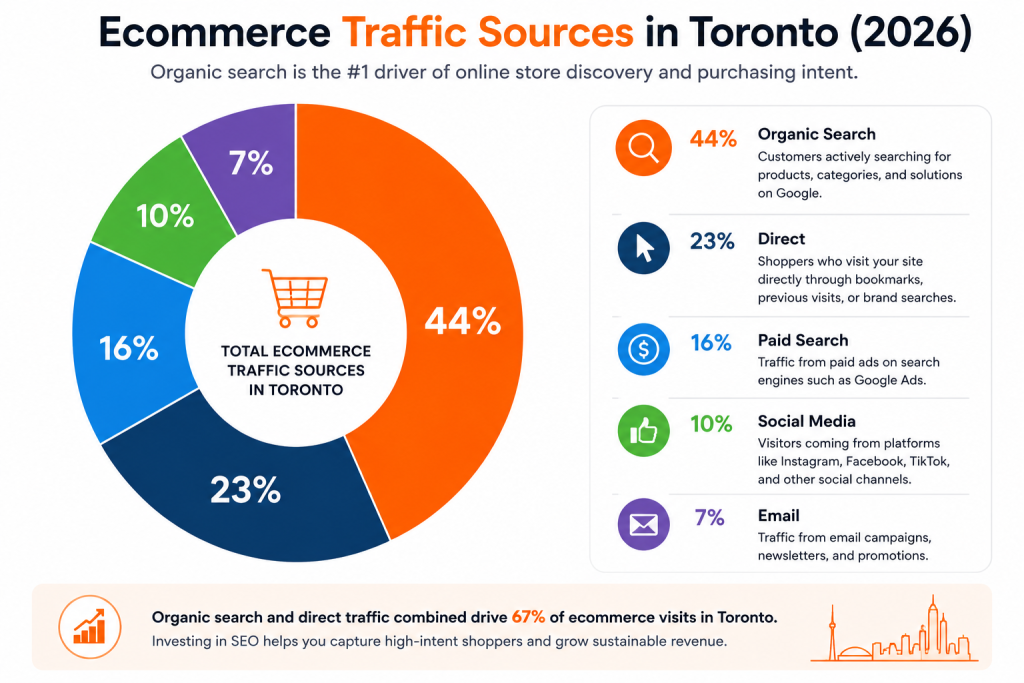
Unlike paid ads, SEO builds long term discoverability. A well optimized ecommerce website can continue attracting shoppers month after month through product pages, category pages, buying guides, reviews, and technical search improvements.
Why Ecommerce SEO Matters in Toronto
Toronto shoppers are not all searching the same way.
Someone in downtown Toronto may care about fast delivery, same day pickup, and product availability. A shopper in Scarborough may compare pricing, shipping options, and reviews. A customer in North York, Etobicoke, Mississauga, or Vaughan may search with local modifiers or look for stores that offer both online shopping and nearby fulfillment.
This is why Toronto ecommerce SEO needs more than broad national keyword targeting. It needs a strategy that understands local buyer behaviour, product intent, and conversion friction.
The Canadian ecommerce market continues to grow. The International Trade Administration estimated Canada’s ecommerce market at US$41.79 billion in 2025, with projected growth to US$66.89 billion by 2030. Statistics Canada has also reported that ecommerce sales remained structurally higher after the pandemic, showing that online buying habits became part of the long term retail landscape.
For Toronto businesses, this creates both opportunity and pressure. More customers are buying online, but more competitors are investing in search, paid media, marketplaces, and conversion optimization.
What Makes Ecommerce SEO Different From Regular SEO
Ecommerce SEO is more complex than optimizing a standard service website.
A service business may need ten to twenty core pages. An ecommerce store may have hundreds or thousands of URLs across product pages, category pages, filters, collections, blogs, and checkout paths.
This creates unique SEO challenges. Product variants can create duplicate content. Filtered URLs can waste crawl budget. Thin product descriptions can reduce rankings. Slow product pages can hurt conversions. Out of stock products can cause traffic loss if handled poorly.
The best ecommerce SEO strategies focus on both visibility and revenue. Ranking is useful only if the page attracts the right shopper and helps them move closer to purchase.
The Foundation: Category Pages, Product Pages, and Technical SEO
For most ecommerce stores, category pages are the biggest SEO opportunity.
| Product Pages | Category Pages |
|---|---|
| Target specific products | Target broader buying intent |
| Limited keyword range | Wider keyword coverage |
| Often lower traffic | Higher scalable traffic |
| Lower internal authority | Stronger SEO structure |
| Transaction focused | Discovery and conversion focused |
A category page targeting “women’s winter boots Toronto” or “organic skincare Canada” can capture shoppers who are still comparing options but have clear buying intent. These pages need more than product grids. They should include helpful intro copy, filters, internal links, FAQs, and trust signals that make it easier for both Google and shoppers to understand the page.
Product pages also matter. Each product page should clearly explain what the product is, who it is for, what problem it solves, and why the customer should buy from your store. Generic manufacturer descriptions rarely perform well because competitors may be using the exact same copy.
Technical SEO is equally important. Google recommends strong Core Web Vitals because loading performance, interactivity, and visual stability affect user experience. For ecommerce websites, speed is not just a ranking issue. It directly affects revenue. Research cited by performance studies has found that even a 0.1 second improvement in mobile load time can improve ecommerce conversions by 8.4 percent.
Toronto Ecommerce Search Intent
A strong ecommerce SEO campaign starts by understanding search intent.
Some shoppers are still researching. Others are comparing products. Others are ready to buy. Your website should have content for each stage.
| Search Intent | Example Query | Best Page Type |
|---|---|---|
| Research | best running shoes for winter Toronto | Buying guide |
| Comparison | leather sofa vs fabric sofa Canada | Blog or guide |
| Category | women’s boots Toronto | Category page |
| Product | Nike trail running shoe size 8 | Product page |
| Local purchase | skincare store near me Toronto | Location or local page |
This is where many ecommerce brands miss revenue. They focus only on product pages and ignore the research and comparison searches that happen earlier in the buying journey.
The brands that win organic traffic usually build a full content ecosystem. Category pages capture commercial intent. Product pages capture specific purchase intent. Blogs and guides answer questions. Local pages support Toronto and GTA visibility.
Content That Supports Ecommerce Growth
Content for ecommerce should not feel like filler.
It should answer questions that help people buy with more confidence. This can include sizing guides, material comparisons, product care advice, gift guides, seasonal buying guides, and category explainers.
For Toronto brands, content can also connect products to local lifestyle. A furniture store can create guides around condo living in Toronto. A clothing retailer can write about winter layering for Canadian weather. A food brand can create content around local delivery, events, or gifting occasions.
Good ecommerce content does three things at once. It improves rankings, educates buyers, and supports conversions.
Reviews, Trust, and Conversion Signals

Reviews play a major role in ecommerce SEO because they help both search engines and customers understand quality. Product reviews can improve trust, increase click through rates, and add fresh user generated content to pages. Store reviews also matter, especially for local Toronto brands competing against larger retailers and marketplaces.
Trust signals should be visible across the buying journey. Customer reviews have become one of the strongest ecommerce trust signals because shoppers often evaluate reputation before deciding where to purchase online. Read more.
Customers want to know if shipping is fast, returns are simple, checkout is secure, and customer support is accessible. For high value products, trust becomes even more important. Buyers often need reassurance before purchasing furniture, electronics, wellness products, equipment, or specialty goods online.
What to Prioritize First
If your ecommerce SEO budget is limited, start with the areas most likely to affect traffic and revenue.
First, fix technical issues that prevent Google from crawling and indexing important pages. Then improve your highest value category pages. After that, rewrite product descriptions for best selling or high margin products. Once the core pages are stronger, build helpful content that supports search intent and internal linking.
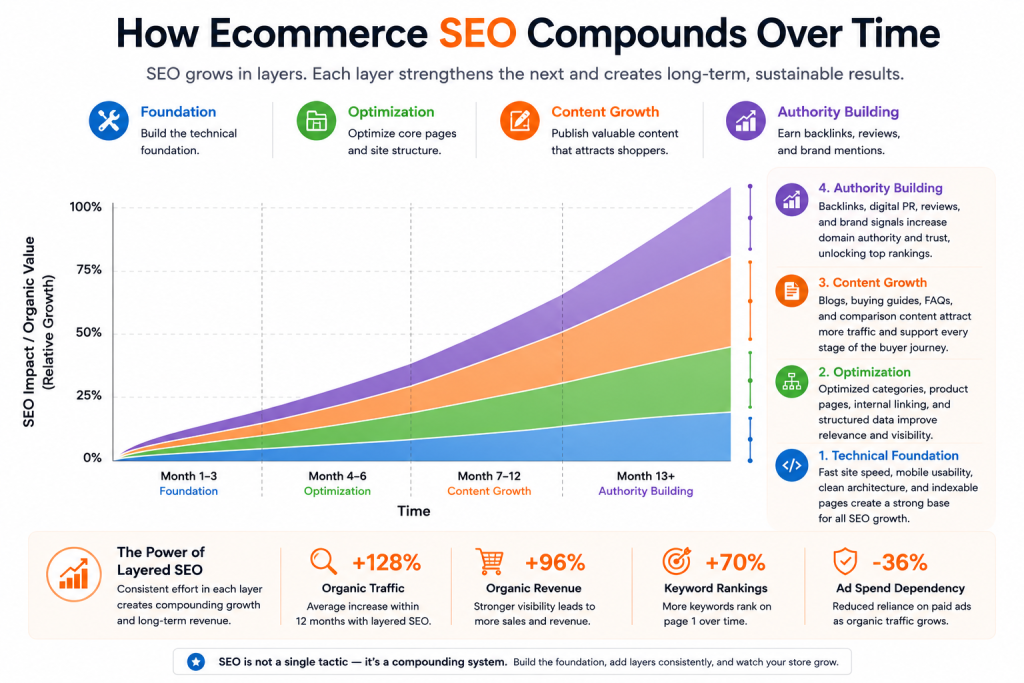
A useful graph for this section would compare traffic growth over six months across three areas: technical fixes, category optimization, and content publishing. The point would be to show that ecommerce SEO grows through layers, not one isolated tactic.
Final Thoughts
Ecommerce SEO in Toronto is not just about ranking product pages. It is about building a search experience that reflects how local shoppers research, compare, and buy. The strongest ecommerce brands combine technical SEO, category optimization, product content, reviews, speed, local relevance, and conversion strategy.
Toronto is competitive, but that also means the opportunity is significant. Brands that invest in SEO now can build long term visibility, reduce dependence on paid ads, and create a stronger path from search to sale. Learn how ecommerce companies are using organic search to reduce their long term reliance on rising paid advertising costs.
Ready to Grow Your Ecommerce Store With SEO?
Canopy Media helps ecommerce brands improve search visibility, product discovery, website performance, and conversion opportunities across Toronto, Canada, and North America.