If you’re deciding between Google Ads and Facebook Ads for your local business, you’re choosing between two fundamentally different customer acquisition strategies. One captures people who are already searching. The other creates demand before the search even happens. Understanding how and when to use each is what separates profitable campaigns from wasted spend.
Why This Decision Matters
Local businesses operate with tighter margins and shorter sales cycles. You don’t have months to “figure it out.” Your ads need to generate leads quickly and consistently.
That’s why choosing the right platform, or combination, has a direct impact on revenue.
What many business owners underestimate is how much this decision affects not just lead volume, but lead quality. Two campaigns can generate the same number of leads, yet produce completely different revenue outcomes depending on intent.
Google Ads vs Facebook Ads: Core Differences
Here’s a clear side by side comparison:
| Factor | Google Ads | Facebook Ads |
| User Intent | High (people are searching) | Low (people are browsing) |
| Traffic Type | Demand capture | Demand generation |
| Avg Cost Per Click | $3 – $10+ | $0.75 – $3 |
| Conversion Rate | 8% – 15% | 1% – 5% |
| Speed of Results | Immediate | Slower, requires testing |
| Lead Quality | High | Moderate |
| Best Use Case | Ready-to-buy customers | Awareness & offers |
This table highlights the core truth: Google Ads captures existing demand, while Facebook Ads creates new demand.
Cost Breakdown: Clicks vs Actual Customers
A deeper look at cost shows why many businesses misjudge performance.
| Metric | Google Ads | Facebook Ads |
| Avg Cost Per Click | $5 | $1.50 |
| Avg Conversion Rate | 10% | 3% |
| Clicks to Get 1 Lead | 10 | 33 |
| Cost Per Lead | $50 | ~$49.50 |
At first glance, both platforms appear nearly identical in cost per lead. But this is where surface level analysis becomes misleading. Not all leads are equal, and this difference becomes obvious when you track what happens after the form fill or phone call.
ROI Comparison: What Actually Drives Revenue
This is where the gap becomes clearer.
| Metric | Google Ads | Facebook Ads |
| Lead Quality | High | Medium |
| Close Rate (avg) | 30% | 10% |
| Customers per 10 Leads | 3 | 1 |
| True Cost Per Customer | Lower | Higher |
Even if Facebook generates cheaper leads, businesses often need significantly more of them to generate the same number of paying customers. This is why experienced advertisers focus less on cost per click and more on cost per acquisition and lifetime value.
How Customer Intent Changes Everything
The biggest difference between these platforms comes down to timing.
Google Ads reaches people at the moment they are actively looking for a solution. This creates a natural alignment between the user’s need and your offer, which is why conversions happen quickly.
Facebook Ads, on the other hand, introduces your business earlier in the decision-making process. At this stage, the customer may not feel urgency yet. Your job is to create interest, build familiarity, and stay visible until they are ready.
This difference explains why Google often feels more “predictable,” while Facebook requires more testing and patience to see results.
When Google Ads Is the Better Investment
Google Ads performs best when your service solves an immediate problem.
Businesses like plumbers, electricians, dentists, and legal services benefit the most because their customers are actively searching and ready to take action. In these situations, visibility at the top of search results directly translates into calls and booked appointments. The path from search to conversion is short, which makes performance easier to measure and scale.
When Facebook Ads Delivers Better Results
Facebook Ads works best earlier in the customer journey.
It is particularly effective for businesses that rely on awareness, branding, or offers to drive action. Gyms, salons, clinics, and restaurants often benefit from this approach because they can influence customer decisions before competitors enter the picture. However, success depends heavily on creative quality and messaging. Unlike Google Ads, where intent does much of the work, Facebook Ads requires you to capture attention and create motivation.
The Smart Strategy: Combining Both Platforms
The highest-performing local businesses don’t choose between Google Ads and Facebook Ads, they use both strategically.
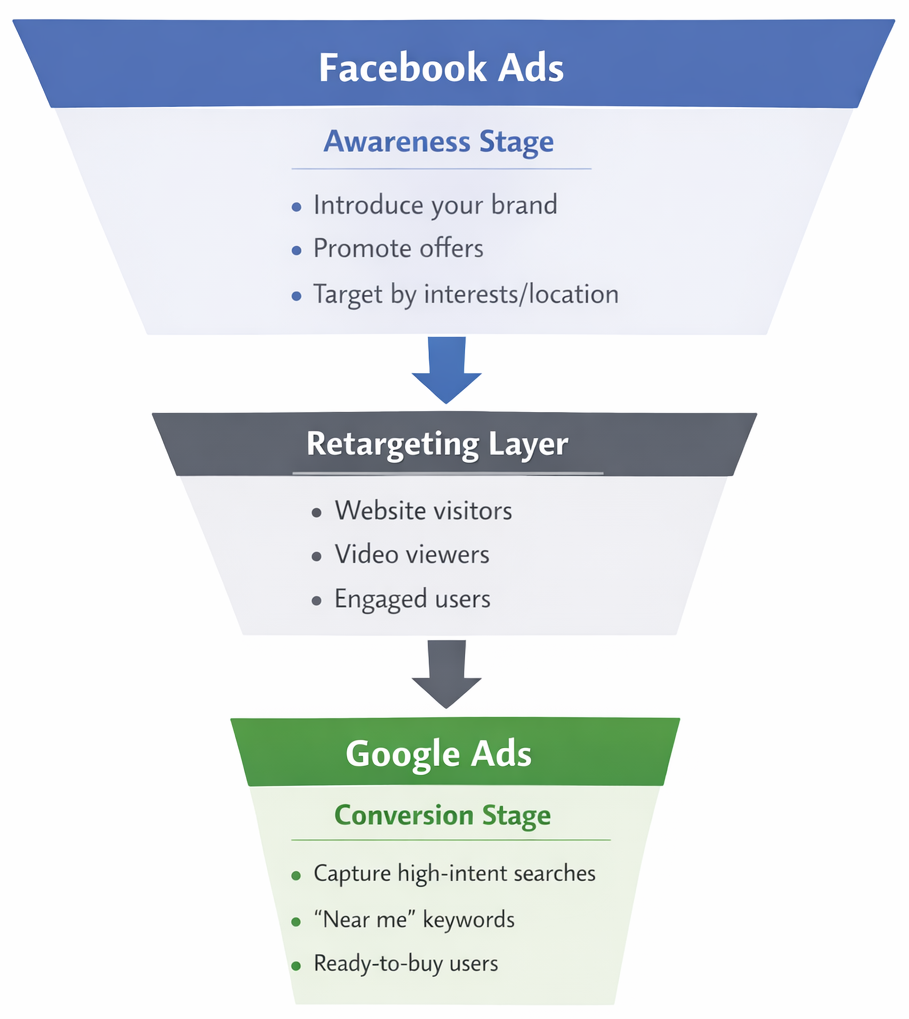
Here’s how that looks in practice:
| Stage | Platform | Objective |
| Awareness | Facebook Ads | Introduce your business |
| Consideration | Facebook Retargeting | Build trust |
| Conversion | Google Ads | Capture high-intent searches |
This approach allows you to guide potential customers through the entire journey instead of relying on a single touchpoint.
It also improves efficiency over time. As more people become familiar with your brand through Facebook, your Google Ads performance often improves because users are more likely to recognize and trust your business when they search.
How to Decide Which Platform to Prioritize
If you’re still unsure where to start, the decision becomes easier when you look at how your customers behave.
If people frequently search for your service with urgency, Google Ads should be your primary focus. This is where you’ll generate the fastest and most consistent return.
If your service requires more consideration or isn’t something people search for daily, Facebook Ads becomes more valuable. It allows you to stay visible and influence decisions over time.
Another factor to consider is your sales cycle. Short sales cycles tend to perform better on Google Ads, while longer decision-making processes benefit from repeated exposure through Facebook.
Many local businesses find success by starting with Google Ads to generate immediate leads, then gradually layering in Facebook Ads to build a longer-term pipeline.
A Costly Mistake to Avoid
Many businesses choose Facebook Ads because it appears cheaper, expecting immediate results. Others jump into Google Ads without proper targeting and burn through the budget quickly.
The issue isn’t the platform, it’s the strategy behind it. Without the right structure, even the best advertising channels will underperform.
Want Better Results From Your Ads?
If you want a clearer structure for improving performance, a PPC checklist can help identify what’s holding your campaigns back. And if you’re looking to scale faster, working with a team that specializes in local PPC can significantly improve both efficiency and results.
Conclusion
When comparing Google Ads vs Facebook Ads for local businesses, the real answer isn’t choosing one, it’s understanding how each fits into your growth strategy.
Google Ads captures demand. Facebook Ads creates it.
Used together, they form a system that consistently attracts, nurtures, and converts customers.
If you’re serious about getting better results from your ad spend, the next step is making sure your strategy is set up correctly from the start. Whether your goal is to generate more qualified leads, reduce your cost per acquisition, or scale your campaigns profitably, execution matters just as much as platform choice.
At Canopy Media, we specialize in helping local businesses build high performing PPC systems that actually drive revenue, not just clicks. If you’re ready to take the guesswork out of your advertising, explore our PPC management services or get in touch to see how we can help you grow faster and more efficiently.