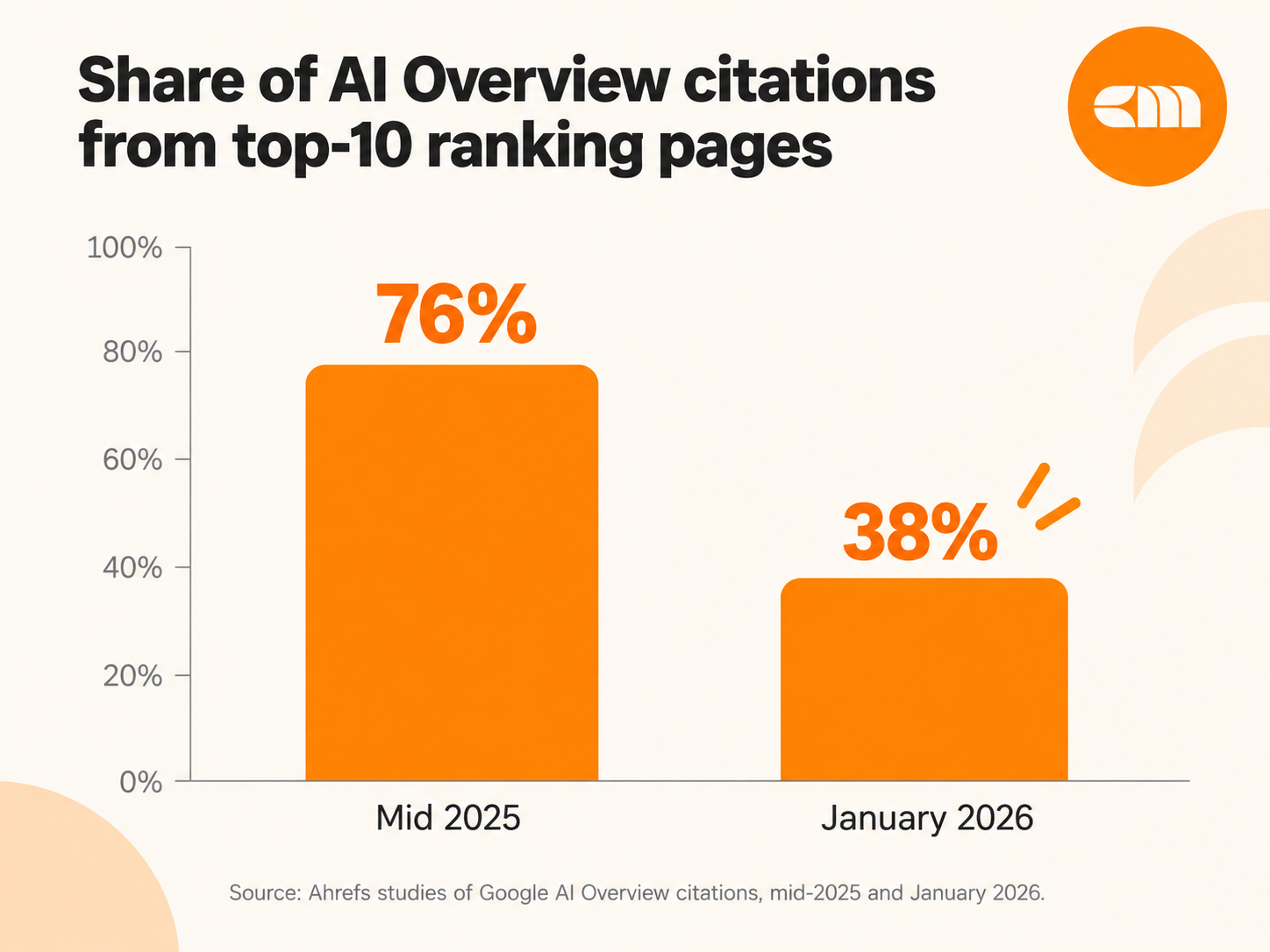
A year ago, if you wanted your business quoted in Google’s AI Overviews, the advice was simple and it was correct: rank in the top ten. Ahrefs studied 1.9 million citations in mid-2025 and found that 76% of cited pages were doing exactly that.
They re-ran the study in January across 863,000 searches and about four million citations. The figure is now 38%. Roughly 31% of what the AI cites doesn’t rank anywhere in the top hundred results.
That isn’t a small drift. It means the thing most businesses are paying for, position on a results page, has become a much weaker predictor of the thing they increasingly want, which is being the source an AI answer is built from.
What actually changed under the hood
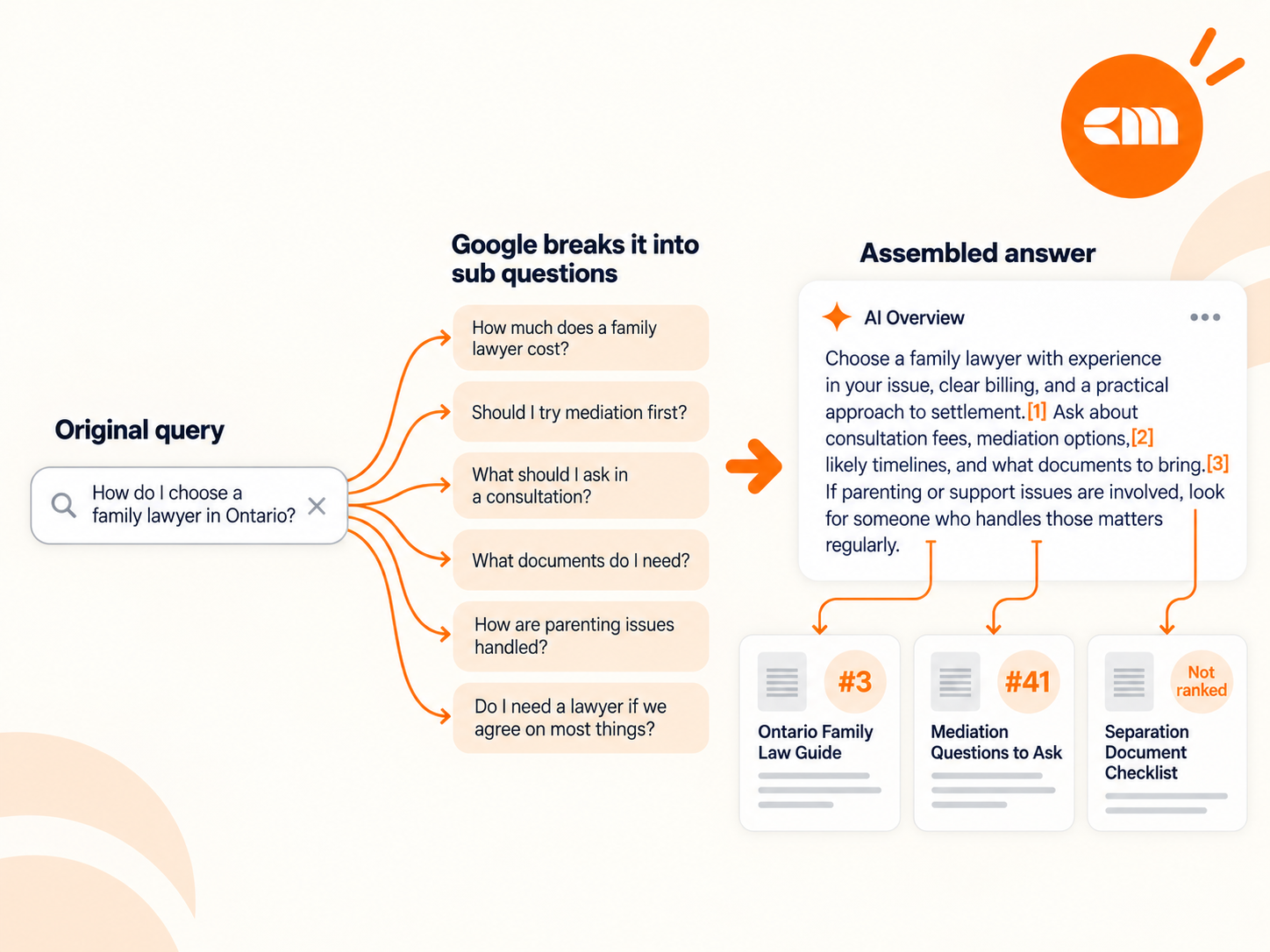
Google’s AI doesn’t read your search results page and summarize it. It takes the question, breaks it into a spray of related sub-questions it thinks the person really means, runs those separately, and assembles an answer from whatever comes back. The industry calls this query fan-out.
The practical consequence is that you’re no longer competing for one query. You’re competing for the twenty quieter questions hiding inside it, most of which you’ve never seen in a keyword tool because nobody types them. A page that ranks 34th for your money term can be the best available answer to one of those sub-questions, and get cited while you don’t.
So AI visibility and ranking are now two overlapping jobs rather than one. Traditional SEO still does most of the heavy lifting, since Google is still sending the overwhelming majority of the world’s referral traffic and about 69% of AI-cited pages do at least rank somewhere in the top hundred. But treating citations as a free side effect of rankings is how businesses end up quietly absent from a channel they assumed they’d inherit.
The measurement trap nobody warns you about
Here is the finding that should change how you read your reports. In June, Semrush and Kevin Indig examined nearly 4,000 domain appearances across 115 prompts in fourteen countries. In 61.7% of them, the site was used as a source, complete with a citation link, and the brand’s name never appeared anywhere in the answer the reader actually read.
They call these ghost citations, which is about right. Your content did the work. Someone else’s name, or nobody’s, got the credit.
That splits AI visibility into two numbers that behave differently. Citation rate is roughly a content and authority problem: does this page deserve to be the source. Mention rate is a brand problem: when the topic comes up, does the model name you unprompted. A site can be strong on one and invisible on the other, and the fixes aren’t interchangeable. If your agency is reporting a single “AI visibility score,” ask which of the two it’s measuring.
The off-site finding that should annoy every SEO
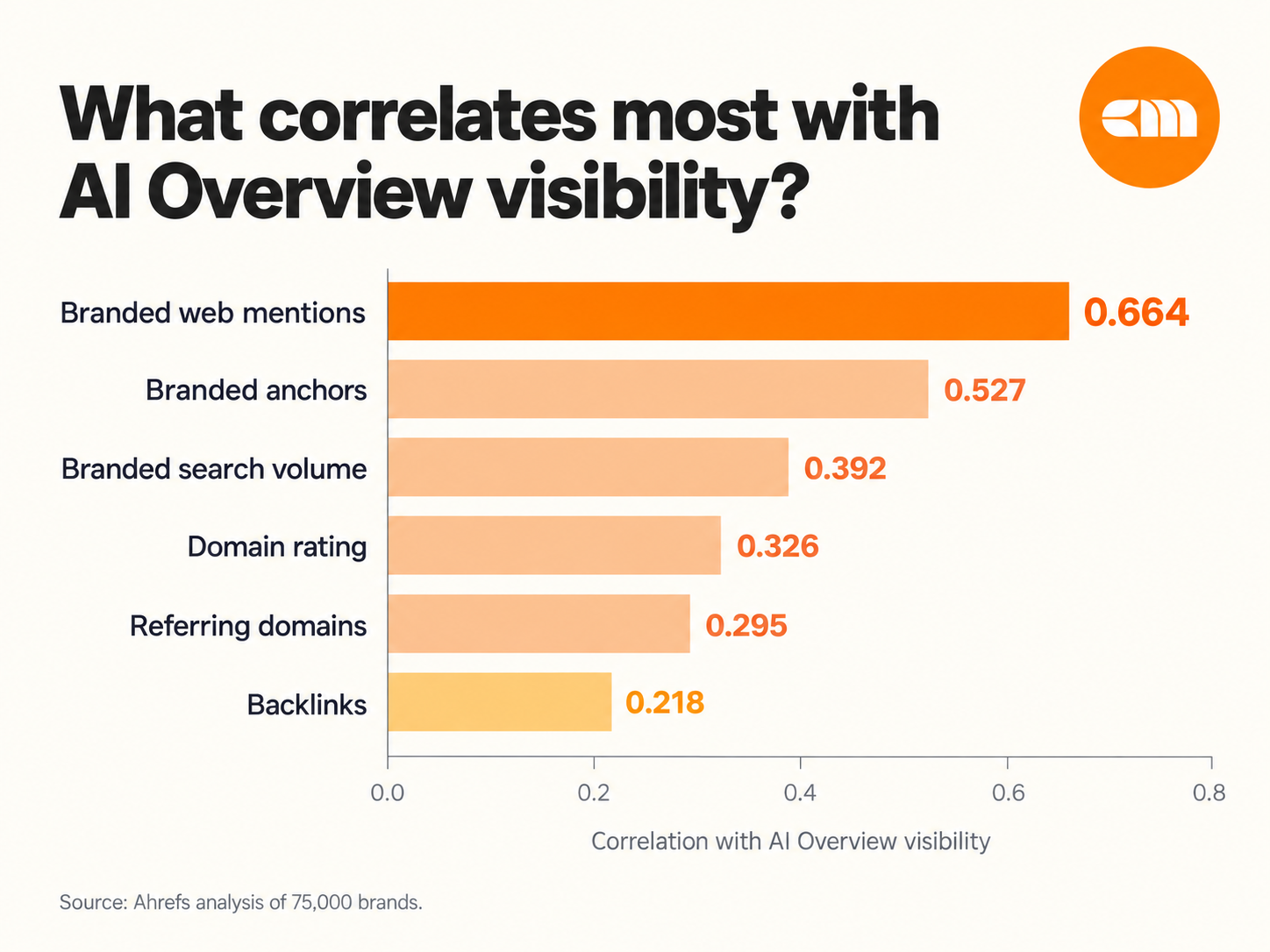
When Ahrefs looked at 75,000 brands and correlated various signals against AI Overview visibility, branded web mentions came out on top at 0.664. Backlinks, the currency our industry has traded in for twenty years, scored 0.218. Branded anchors, branded search volume and domain rating all landed in between.
Read that again, because it reverses a long-standing assumption. Being talked about, in plain text, with no link attached, appears to matter more than being linked to. Which makes sense once you remember that a language model learns from text, not from the link graph.
For a manufacturer or a law firm, that reframes the off-site work entirely. Trade publications, association member listings, industry directories, supplier and partner pages, the specialist forums and subreddits where your buyers compare notes. Not for the link. For the sentence with your name in it.
What we’d tell you not to bother with
Two things get sold hard right now and deserve honesty.
Schema markup is useful infrastructure and does not buy you citations. A Search/Atlas analysis found no correlation between schema coverage and citation rates. It helps machines extract facts accurately, it supports traditional search, and it is not a lever you can pull for growth.
And llms.txt, currently the most marketed file on the internet, is not used by Google. Gary Illyes said so at a Search Central event in mid-2025: Google doesn’t support it and isn’t planning to. Other engines treat it differently and it takes an hour to publish, so we still ship one. We just don’t invoice anyone for hope.
The order that works
If you’re doing this on your own site, sequence matters more than effort:
- Fix the facts first. One consistent version of your name, locations, service lines and credentials, everywhere they appear.
- Restructure your highest-intent pages so the direct answer sits above the context, not below it.
- Go get unlinked mentions in the places your buyers already read.
- Ship the technical basics, quickly, then stop thinking about them.
- Track citation rate and mention rate separately, against a fixed list of prompts real buyers would use.
Step five is the one that turns this from a trend into a channel. Everything before it is guessing.
If you want to know where you currently stand, we’ll run your domain through the same prompt set we use for clients and send you what comes back. No call required.