If you run a small business in Houston, you’ve probably noticed your customers stopped scrolling and started asking. They type full questions into Google, they ask ChatGPT for a recommendation, and they read the AI summary at the top of the page instead of clicking through to ten blue links. That shift is the whole reason “AI-driven SEO” exists as a category, and it’s why the old playbook of stuffing a page with “Houston plumber” fifty times no longer moves anything.
Customers increasingly receive answers before scrolling through traditional search results.
Here’s the plain version of what AI-driven SEO actually means. It’s using machine learning to do the parts of SEO that used to eat entire afternoons: finding the questions your customers really ask, spotting the technical issues slowing your site down, and structuring your content so both Google and AI assistants can quote it back to a searcher. The strategy is still human. The grunt work is faster, and the pattern-finding is sharper than a person squinting at a spreadsheet.
H2: Why Houston small businesses feel the AI shift first
| Year | Traditional Search | AI Assisted Search |
| 2022 | 95% | 5% |
| 2023 | 90% | 10% |
| 2024 | 82% | 18% |
| 2025 | 68% | 32% |
| 2026 | 52% | 48% |
Illustrative trend based on the rapid adoption of AI search tools.
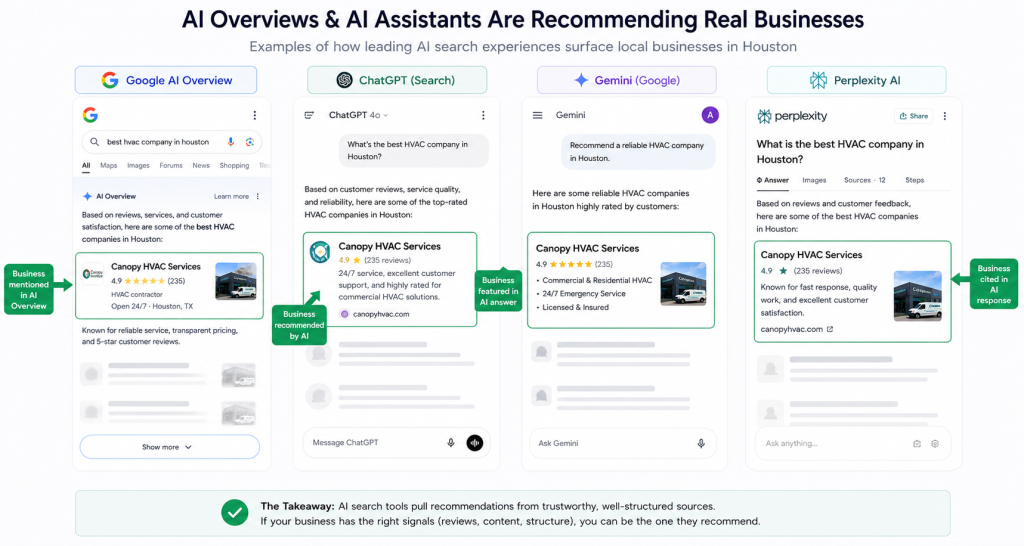
Houston is competitive in a way that punishes vague marketing. You’re not ranking against the whole internet, you’re ranking against the roofer three ZIP codes over who also wants the Katy and Sugar Land jobs. Local intent is high here, and local intent is exactly what AI search has gotten good at. When someone asks their phone for “an HVAC company near me that services commercial units,” the engine isn’t matching keywords anymore. It’s reading reviews, business hours, service-area data, and the actual language on your site to decide who to name.
That last part is the shift that catches people off guard. Search used to reward whoever repeated the phrase most. Now it rewards whoever answers the question most clearly and can prove they’re a real, trusted local business. A tradesperson with forty genuine five-star reviews and a fast, well-structured site will often get named by an AI assistant over a competitor who spent more on ads. For a small business with a modest budget, that’s good news, because it means clarity and reputation beat spend more often than they used to.
There’s a catch worth stating plainly. If your site isn’t one of the sources these tools consider trustworthy, you’re invisible in the exact spot most people now look first. The AI summary answers the question, the searcher never scrolls, and you never existed as far as they’re concerned. That’s the difference between a steady phone and a quiet one, and it’s why “just having a website” is no longer the finish line.
H2: What AI-driven SEO includes, and what it doesn’t
| AI Does Faster | Humans Still Do Better |
| Keyword clustering | Strategy |
| Technical audits | Business understanding |
| Internal linking suggestions | Sales messaging |
| Schema recommendations | Brand voice |
| Content briefs | Final content quality |
We’ll be candid, because pretending AI does everything is how agencies oversell. AI doesn’t replace SEO work, it accelerates specific pieces of it. The parts where it genuinely helps are these:
- Topic and question research, surfacing the phrasing real customers use, including the long conversational queries that older keyword tools miss entirely.
- Technical audits, flagging crawl-depth, page-speed, and indexing problems in minutes instead of the days a manual review takes.
- Content structuring, formatting your answers so they’re eligible to be pulled into AI Overviews and assistant responses rather than buried three scrolls down.
What it doesn’t do is invent trust. Google still weighs real-world experience and reputation heavily, and no model can fake a decade of good reviews or genuine local relevance in your service area. It also can’t fix a slow, badly built site on its own; someone has to do the engineering. So the honest picture is a pairing. AI handles speed and pattern-finding. Humans handle judgment, accuracy, and the technical builds that actually hold up when Google’s algorithm shifts again, which it will.
H2: What results actually look like, and when
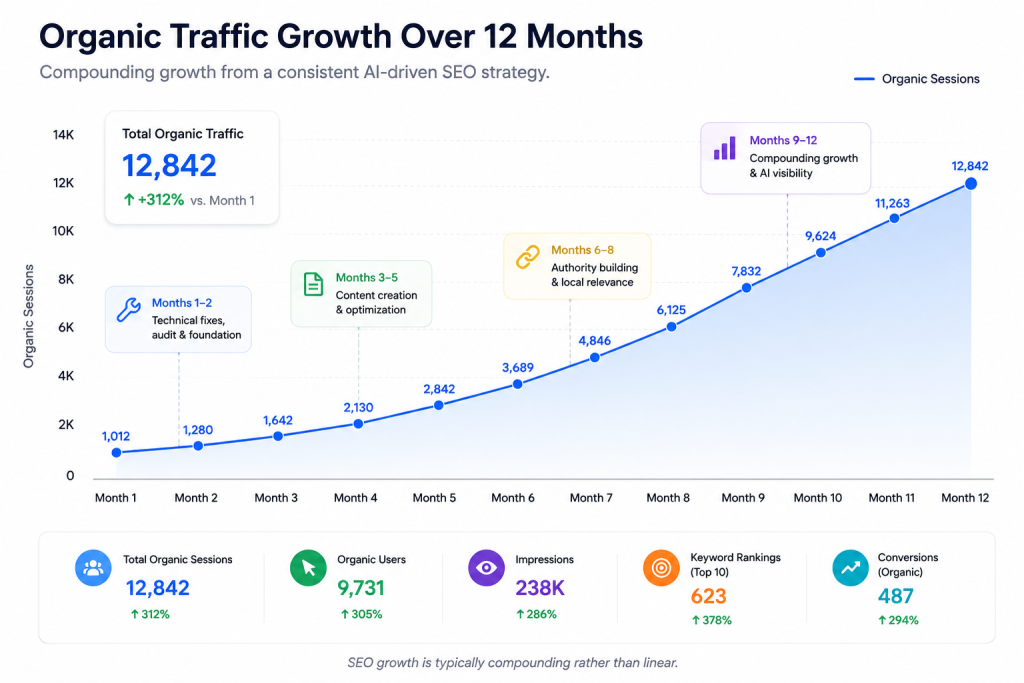
SEO is slow, and anyone promising Houston page-one rankings in 30 days is selling you something. In competitive local niches, expect meaningful movement in six to nine months, sometimes sooner for less contested terms and slower for the ones everyone in the metro is fighting over. The shape matters more than any single month: little visible change early while the technical foundation goes in, then compounding gains once content and authority start stacking. The table below shows the general arc of a first-year engagement. Timings are typical ranges, not guarantees, and your niche will move the numbers.
| Timeframe | Focus | Typical outcome |
| Month 1 to 2 | Technical fixes, local schema, full audit | Site indexes cleanly, page speed improves |
| Month 3 to 5 | Content build, AI-eligible structuring | First rankings on mid-competition terms |
| Month 6 to 9 | Authority building, reviews, refinement | Movement on primary local keywords |
| Month 9 to 12 | Compounding gains, AI Overview presence | Steady organic and assistant referrals |
The reason we’re upfront about the timeline is that the businesses who quit at month three are the ones who lose money. The work compounds, but only if you let it. Pulling the plug right before the curve bends upward is the most expensive mistake we see small businesses make with SEO.
H2: How we work at Canopy
We’re an agency with in-house engineers, which matters more than it sounds. A lot of the AI-search advantage comes down to technical implementation: clean structured data, fast pages, crawlable architecture. We build that ourselves rather than handing you a PDF of recommendations and wishing you luck. When something won’t work for your budget or your timeline, we say so, and we point you at what will.
If you want to see where you stand right now, we’ll run a free AI-search visibility check on your site and show you exactly which queries you’re missing and who’s getting named instead of you. No pitch theatre, just the findings, and you can do whatever you like with them.