If your website is not generating the leads or sales you expected, there is a good chance the problem is not your products or services. More often, the issue lies in how search engines and users experience your website. A professional SEO audit in Toronto uncovers the technical issues, content gaps, and missed opportunities preventing your business from ranking where it should.
Many businesses invest thousands into websites, Google Ads, and content marketing before discovering that simple technical problems are limiting their visibility. Broken internal links, slow loading pages, duplicate content, weak page structure, or poor indexing can quietly reduce your rankings for months without anyone noticing.
An SEO audit identifies those issues before they become expensive.
CTA: Get your free SEO Audit
Why Toronto Businesses Need Regular SEO Audits

Toronto has one of Canada’s most competitive digital markets. Whether you operate in legal services, healthcare, construction, manufacturing, finance, home services, or ecommerce, your competitors are continuously improving their websites.
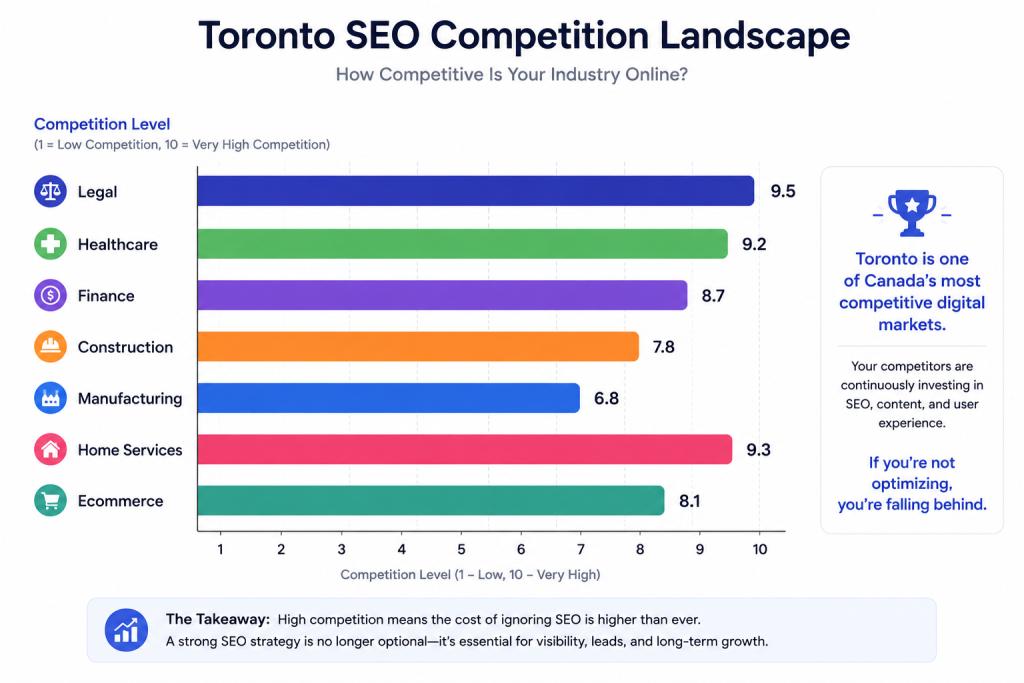
Google also changes its ranking systems thousands of times every year. While most updates are minor, several broad core updates significantly reshape search results annually. A website that ranked well six months ago can gradually lose visibility without anything appearing “broken.”
An SEO audit acts like a complete health check for your website. Rather than guessing why rankings fluctuate, it provides measurable answers backed by data.
What an SEO Audit Actually Examines
A comprehensive SEO audit goes far beyond checking keywords.
Instead, every major ranking factor is evaluated together because search performance depends on how these systems interact.
| Audit Area | What Gets Reviewed | Business Impact |
| Technical SEO | Crawl errors, indexing, Core Web Vitals, site speed | Higher search visibility |
| On Page SEO | Titles, headings, metadata, content quality | Better keyword relevance |
| Content Analysis | Topical coverage, duplicate content, thin pages | Improved authority |
| Internal Linking | Navigation and page relationships | Better crawling and engagement |
| Backlink Profile | Authority, toxic links, referring domains | Increased trust |
| Local SEO | Google Business Profile, citations, location pages | More local leads |
| AI Search Readiness | Structured data, entity optimization, semantic relevance | Greater visibility in AI generated answers |
Each area contributes differently, but together they determine how easily Google understands your website and how confidently it recommends your business.
The Most Common SEO Problems We Find
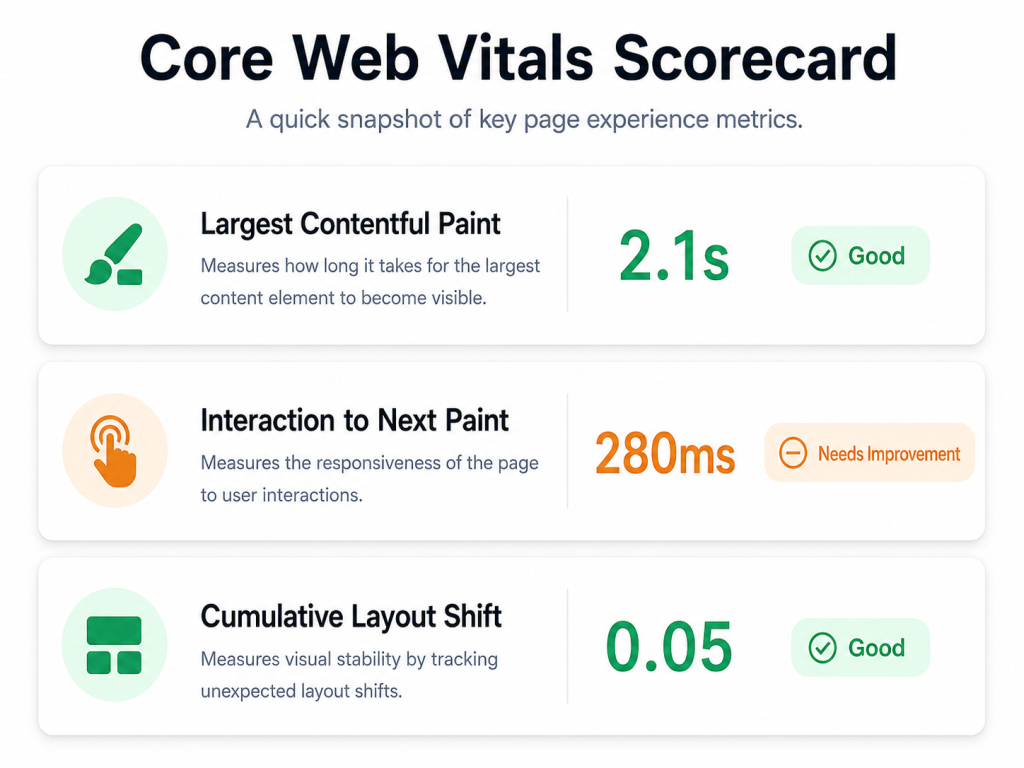
After auditing hundreds of websites, similar patterns appear repeatedly regardless of industry.
Some of the most common issues include:
- Pages that Google has never indexed
- Duplicate service pages competing against each other
- Slow loading images reducing Core Web Vitals scores
- Missing structured data
- Weak internal linking
- Poor location page optimization
- Thin content that fails to satisfy search intent
- Outdated title tags and metadata
- Mobile usability issues
- Orphan pages with no internal links
None of these problems usually cause rankings to disappear overnight. Instead, they slowly reduce a site’s ability to compete while stronger competitors continue improving.
Why Technical SEO Matters More Than Ever
Google has become significantly better at understanding content.
Ironically, that makes technical optimization even more important.
If Google’s crawlers cannot efficiently discover, understand, or index your pages, even excellent content may struggle to rank.
Research consistently shows that page experience influences both user behaviour and search performance.
Average User Behaviour by Page Speed
| Load Time | Bounce Rate Increase |
| 1 second | Baseline |
| 3 seconds | +32% |
| 5 seconds | +90% |
| 10 seconds | +123% |
Source: Google Page Speed research
Typical SEO Performance Relationship

While every website differs, healthier websites generally create stronger long term organic performance because fewer technical obstacles prevent search engines from understanding the site.
SEO Audits Now Include AI Search Optimization
| Traditional | AI Search |
| Keywords | Entities |
| Rankings | Citations |
| Blue Links | AI Answers |
| Metadata | Structured Data |
| Search Volume | User Questions |
Traditional rankings remain important, but search is changing quickly.
Today, users increasingly receive answers from Google AI Overviews, ChatGPT, Gemini, Claude, and Perplexity before they ever click a website.
That changes how SEO audits are performed.
Modern SEO audits now evaluate whether your website is structured for AI systems to confidently reference your content.
This includes reviewing:
- Semantic content organization
- Entity relationships
- Schema markup
- Question based content
- Topical authority
- Content depth
- Citation opportunities
- Clear page hierarchy
Instead of optimizing only for keywords, websites must now optimize for understanding.
The businesses appearing inside AI generated answers are often those with the clearest information architecture rather than simply the highest keyword density.
What Happens After the Audit?
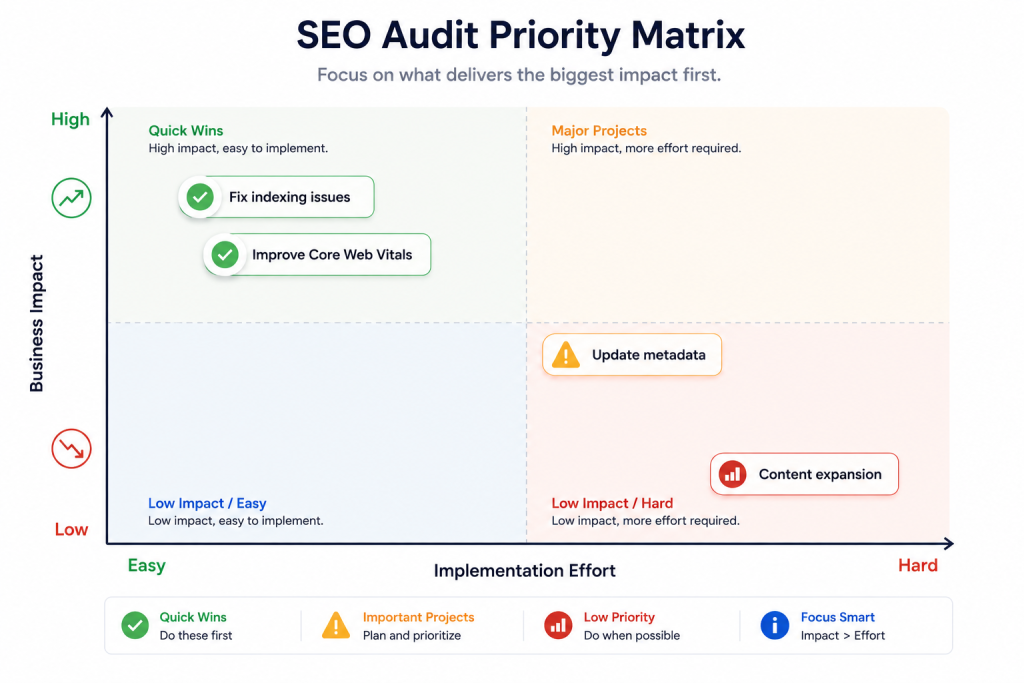
The biggest misconception is that an SEO audit simply produces a long PDF listing problems.
A valuable audit prioritizes recommendations based on business impact.
Instead of presenting one hundred technical observations with no direction, the findings should identify:
High Priority
Issues directly limiting rankings or indexing.
Medium Priority
Opportunities that improve authority, content quality, and user experience.
Long Term Growth
Strategies that strengthen topical authority and AI search visibility over time.
This allows businesses to focus resources where they produce measurable improvements rather than fixing every issue equally.
How Often Should a Website Be Audited?

For most Toronto businesses, a complete SEO audit every six to twelve months is appropriate.
However, additional audits are recommended after:
- Website redesigns
- Domain migrations
- Significant Google algorithm updates
- Large content launches
- Ecommerce platform changes
- Rapid ranking declines
Search is constantly evolving. An audit performed two years ago is unlikely to reflect today’s competitive landscape.
Choosing an SEO Audit Provider in Toronto
Not every SEO audit delivers meaningful insight.
Many automated tools generate reports with hundreds of warnings that offer little business value.
A professional audit combines software with expert analysis. Technical findings should be interpreted in the context of your industry, your competitors, your customer journey, and your commercial objectives.
The result should not simply be a list of errors.
It should become a roadmap for increasing rankings, improving conversions, strengthening local visibility across Toronto, and positioning your website for both traditional search engines and the growing influence of AI powered search.
If your website is not performing as well as it should, an SEO audit is usually the fastest way to understand why. More importantly, it provides a clear plan for turning search visibility into qualified leads and sustainable long term growth.