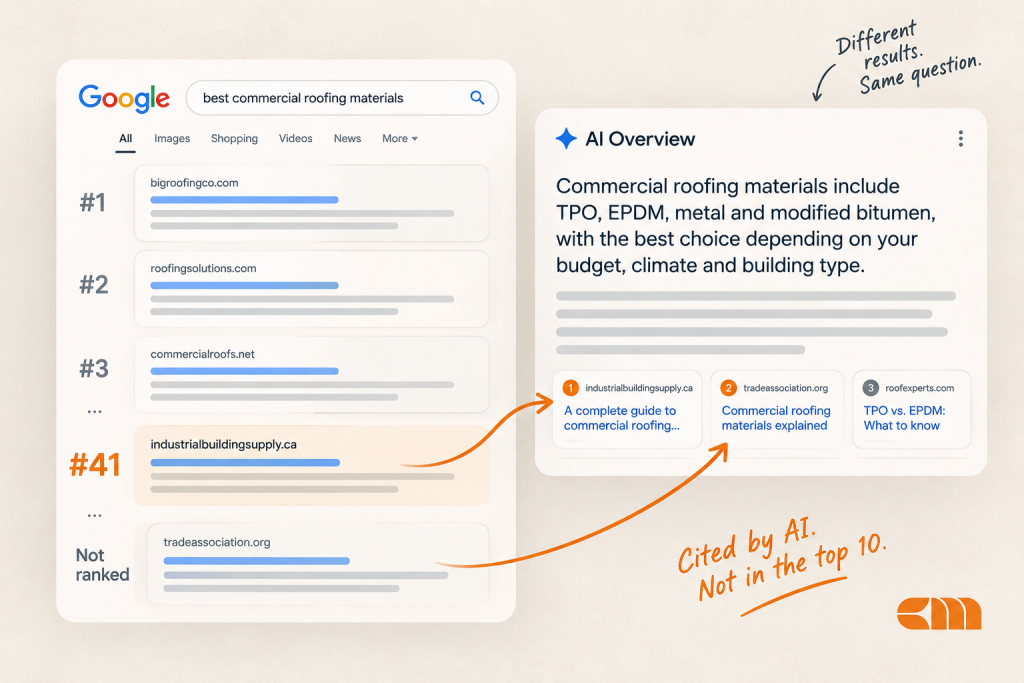
Most accounts should run both, and the question is not which one to pick but which one gets your high intent traffic.
Search campaigns buy declared intent. Somebody typed what they want, and you bid on that. Performance Max buys conversions wherever Google’s models think they are available, across Search, YouTube, Display, Discover, Gmail and Maps, and it decides the mix.
They are not substitutes. They behave very differently when they overlap, and the rules governing that overlap are documented and specific. Understanding those rules is what stops Performance Max quietly eating the traffic your Search campaign was already converting cheaply.
The real differences
| Search | Performance Max |
|---|---|---|
Inventory | Google Search and search partners | Search, YouTube, Display, Discover, Gmail, Maps |
Targeting | Keywords you choose, with match types | Audience signals and search themes that guide, not command |
Creative | Ads you write | Asset groups that Google assembles |
Placement control | High | Limited to exclusions |
Reporting granularity | Query and keyword level | Asset group, channel and asset level |
Best for | Known demand you want to capture precisely | Finding conversions at volume across channels |
Google documents the controls Performance Max does give you: negative keywords and brand exclusions to “prevent overlaps and block unwanted queries,” search themes to guide intent, plus placement exclusions and content suitability settings.
Those controls are meaningfully better than they were at launch, and anyone advising you based on how Performance Max behaved in 2022 is out of date. Reporting has improved too. It is still not keyword level query control, and if that matters to your business you need to know it going in.
The overlap rule that decides everything
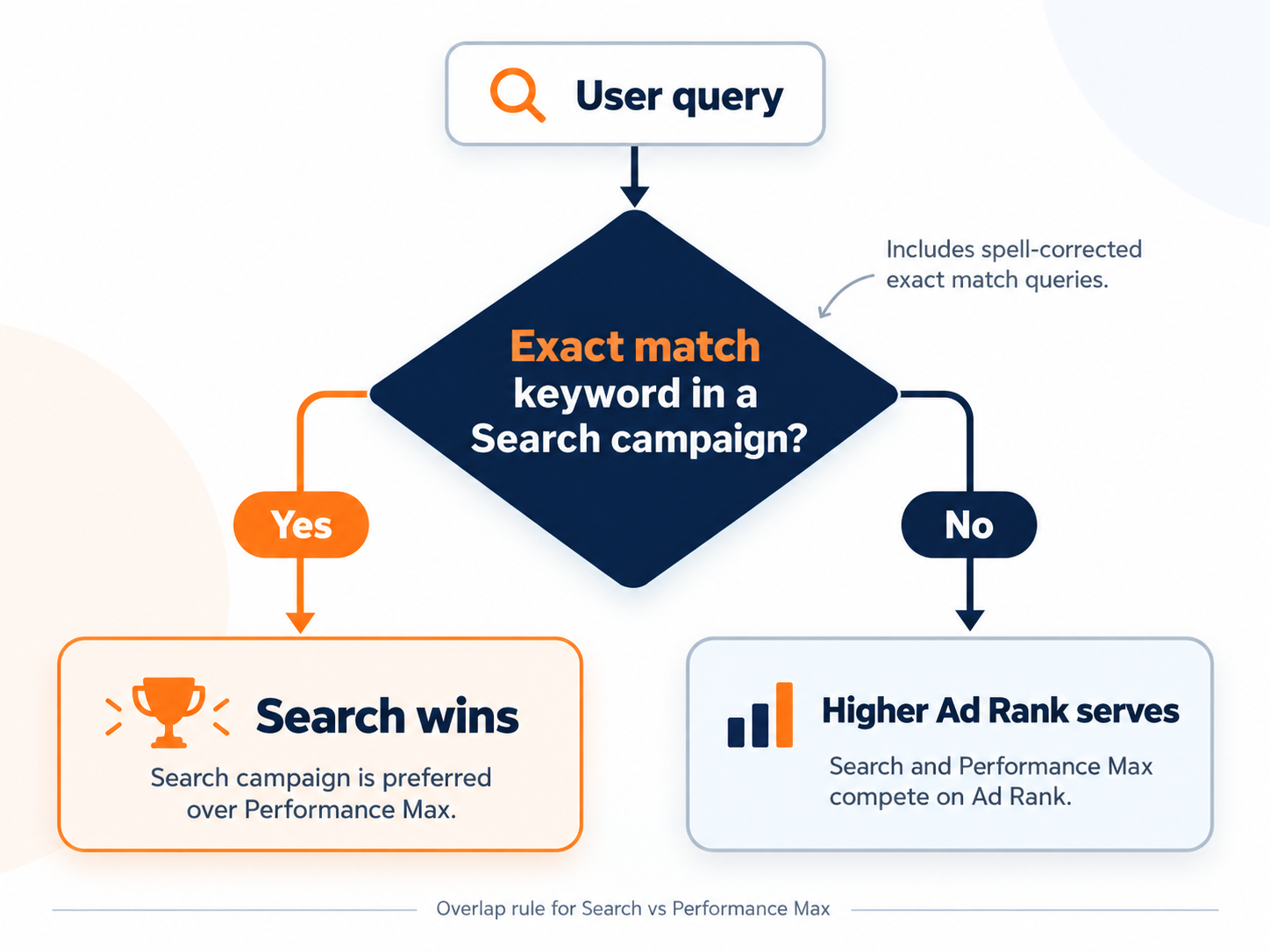
This is the single most useful thing to know, and it is in Google’s documentation rather than in folklore.
“A Search campaign with a keyword that exactly matches or is spell-corrected to a person’s query will be preferred over Performance Max.” Where there is no exact match, “the campaign with the higher Ad Rank will serve”.
Read that carefully, because the consequences are large.
Exact match keywords are protected. If you have an exact match keyword for your brand name, or for your highest converting product term, your Search campaign wins that auction regardless of what Performance Max wants to do.
Phrase and broad match are not protected. Everything you are covering with broad match is in open competition with Performance Max on Ad Rank, and Performance Max often wins because it has more signals and a tuned bid strategy. This is why advertisers report Search volume quietly dropping after launching Performance Max. The traffic did not disappear; it moved campaigns, and became harder to see.
The practical response: promote your proven converting queries to exact match before you turn Performance Max on, and add account level negative keywords, plus brand exclusions if you do not want Performance Max buying your own brand traffic at a flattering cost per acquisition.
Which one suits which business

Performance Max earns its place when you have a product feed and a catalogue with breadth, when you are already getting enough conversions for the models to learn from (roughly 30 or more a month per campaign as a working minimum, more is better), when your conversion is a purchase with a real value attached, and when you have genuinely run out of search volume to capture.
Search deserves the budget instead when conversion volume is low, when your conversion is a form fill or a phone call rather than a sale, when lead quality varies wildly and you need to see which queries produce good ones, when you operate in a regulated category where ad placement matters, and when your business is local and specific.
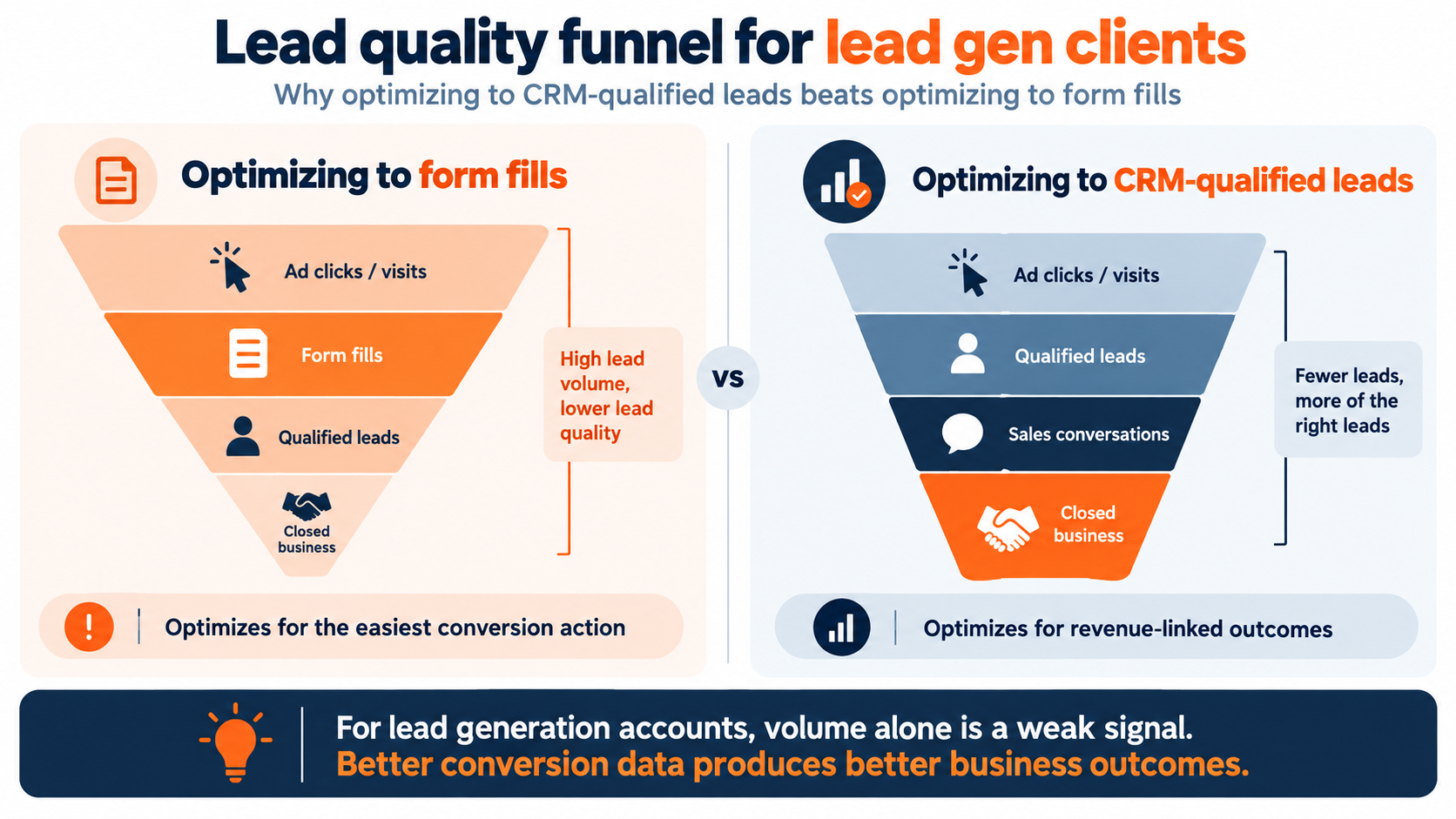
The lead generation caveat is the one we raise most often with clients. Performance Max optimizes toward the conversion action you give it. If that action is “form submitted,” it will find you people who submit forms, and a meaningful share of them will be unqualified. For a law firm or an insurance brokerage, twenty poor leads is worse than five good ones, because your intake team pays for the difference.
The fix is not to avoid Performance Max. It is to feed it a better signal: import qualified lead or closed deal conversions from your CRM with values attached, so the model optimizes toward revenue rather than form fills. If you cannot do that yet, do that first and launch Performance Max afterwards. This is the step most accounts skip, and it is the difference between Performance Max working and Performance Max being expensive.
Running both without fooling yourself
A structure that works for most accounts: Search campaigns holding your brand terms and your proven exact match converters, Performance Max handling everything else, account level negatives keeping the two apart, and brand exclusions on if you do not want Performance Max claiming credit for brand searches.
The measurement traps are worth naming, because they catch experienced people.
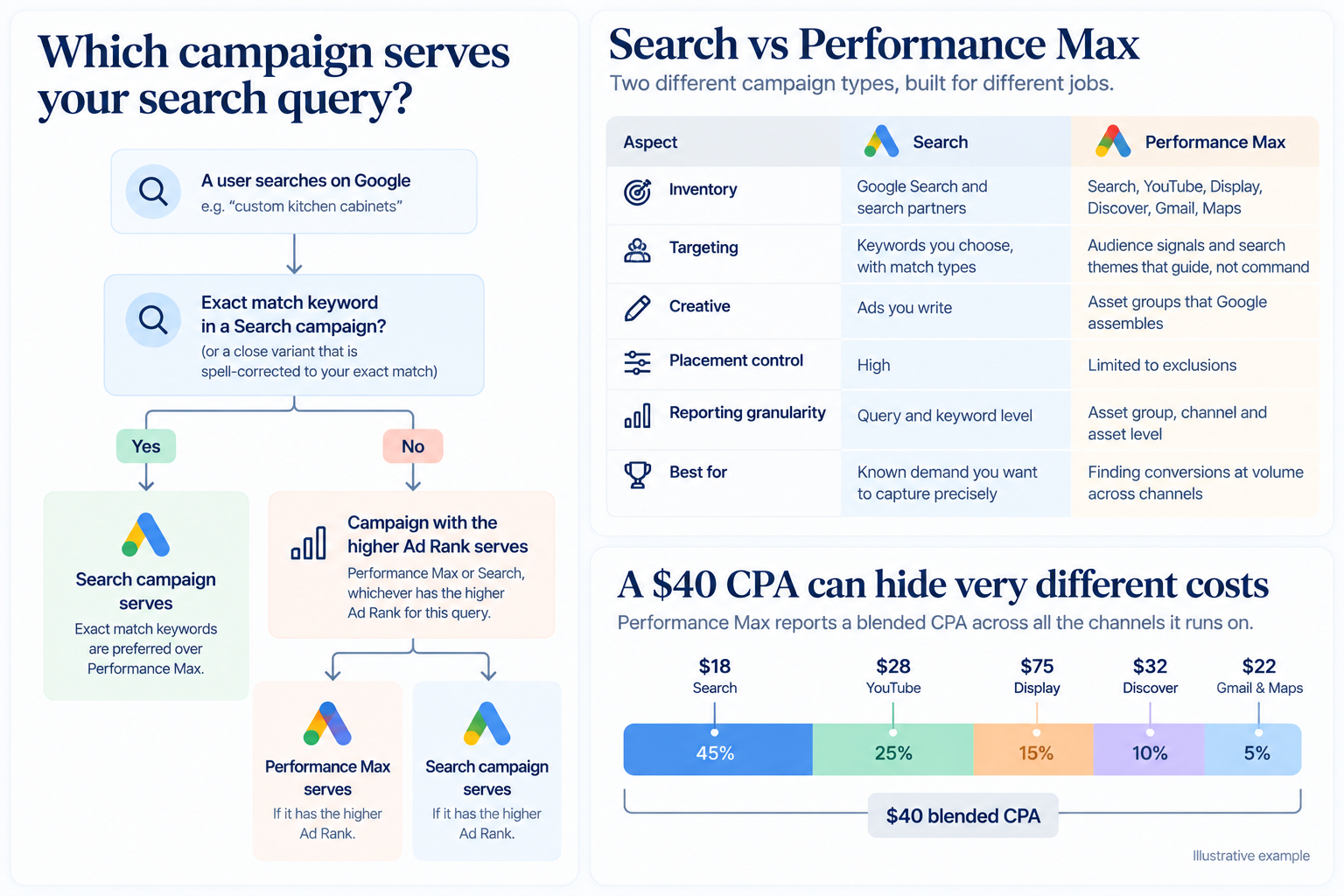
Performance Max reports a blended cost per acquisition across every channel it touches. A campaign showing a $40 CPA may be doing very well on some inventory and very poorly on others, and the average hides both. Use the channel and asset group reporting rather than the headline number.
Incrementality is the harder question. If Performance Max shows people your ad on Display after they already searched for you, it will claim conversions that were going to happen anyway. The only honest test is a holdout: pause it in one region or for one segment for four weeks and watch total conversions, not campaign level ones. Very few advertisers do this. The ones who do often find their true incremental cost per acquisition is higher than reported, sometimes materially.
One thing to watch: Google has been narrowing the gap from the other direction. AI Max for Search, announced in May 2025, brings keywordless matching, automatic text assets and URL expansion into Search campaigns as an opt-in feature suite. Google reports typical uplift of 14% more conversions at similar CPA, which is a vendor figure rather than an independent one, so treat it as a claim to test rather than a fact. The direction is clear enough: the distinction between the two campaign types is getting blurrier, and control is the thing you trade away either way.
How to actually test this

Do not launch Performance Max and compare it to your Search campaign. They are not competing for the same job and the comparison will not tell you anything.
Test it properly. Establish your baseline conversion volume and cost for four weeks. Launch Performance Max with a separate budget rather than by moving money out of Search. Run it for at least six weeks, because the learning period is real and judging it at week two is judging noise. Then look at total account conversions and total spend, not Performance Max’s own report.
If total conversions rose more than total spend, it is working. If Performance Max looks brilliant and your account total is flat, it is taking credit for conversions Search was already producing, and you have learned something useful for the cost of a test.
If you would like someone to look at how your campaigns are overlapping, or to run a holdout test properly, we manage paid search for businesses in USA and Canada and will tell you when Performance Max is not the right answer for your account. For lead generation clients, it often isn’t, at least not yet.