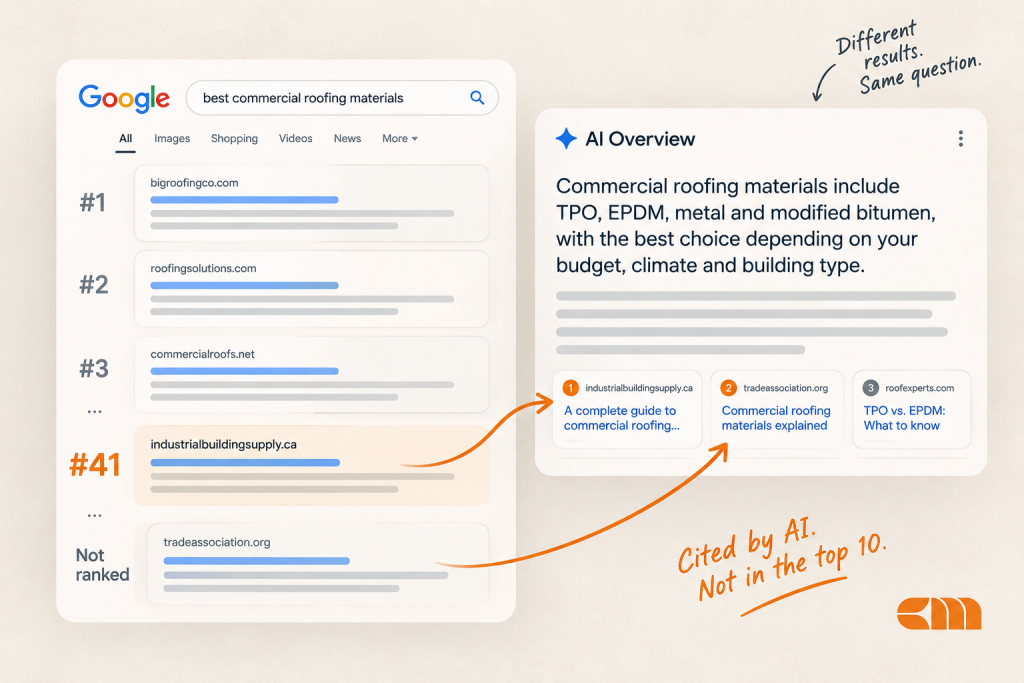
If you are searching for insurance technical SEO services, you have probably already been sold content. Blog posts about whether renters insurance covers flooding. Location pages for eleven cities. Maybe a link building retainer. And the numbers have not moved the way anyone promised.
Often the reason is underneath all of it. Insurance sites tend to be large, old, and assembled over years by three different vendors. They accumulate duplicate product pages, abandoned agent profiles, quote forms that break on mobile, and URL structures nobody can explain. Content sits on top of that foundation and does not fix it.
Technical SEO is the work of making the site crawlable, fast, correctly structured and properly measured, so that everything else has a chance. This is what that work actually involves for an insurance site, what a real engagement looks like, and what to ask a provider before you sign anything.
What the service should actually include
Technical SEO is a vague phrase, so here is the concrete version. A proper engagement on an insurance site covers:
- A full crawl of the site, including the pages nobody remembers publishing
- Index management, deciding what should be in Google and removing what should not
- URL and internal linking structure across products, locations and agents
- Page speed and Core Web Vitals, particularly on quote and contact templates
- Structured data for the organisation, the locations and the agents
- Form, call and quote tracking that survives consent requirements
- A crawl and indexation monitoring setup so problems surface in weeks, not quarters
If a proposal does not name most of these, it is a content proposal wearing a technical label.
There is one more thing insurance sites need that a generic audit will skip. Google’s rater guidelines treat topics affecting someone’s finances as Your Money or Your Life, held to a higher bar for trust signals. In practice that means licence numbers, real named authors, carrier relationships and physical addresses need to be present in the markup and on the page, not just in the footer. That is technical work as much as editorial.
The product and location grid is where most insurance sites break
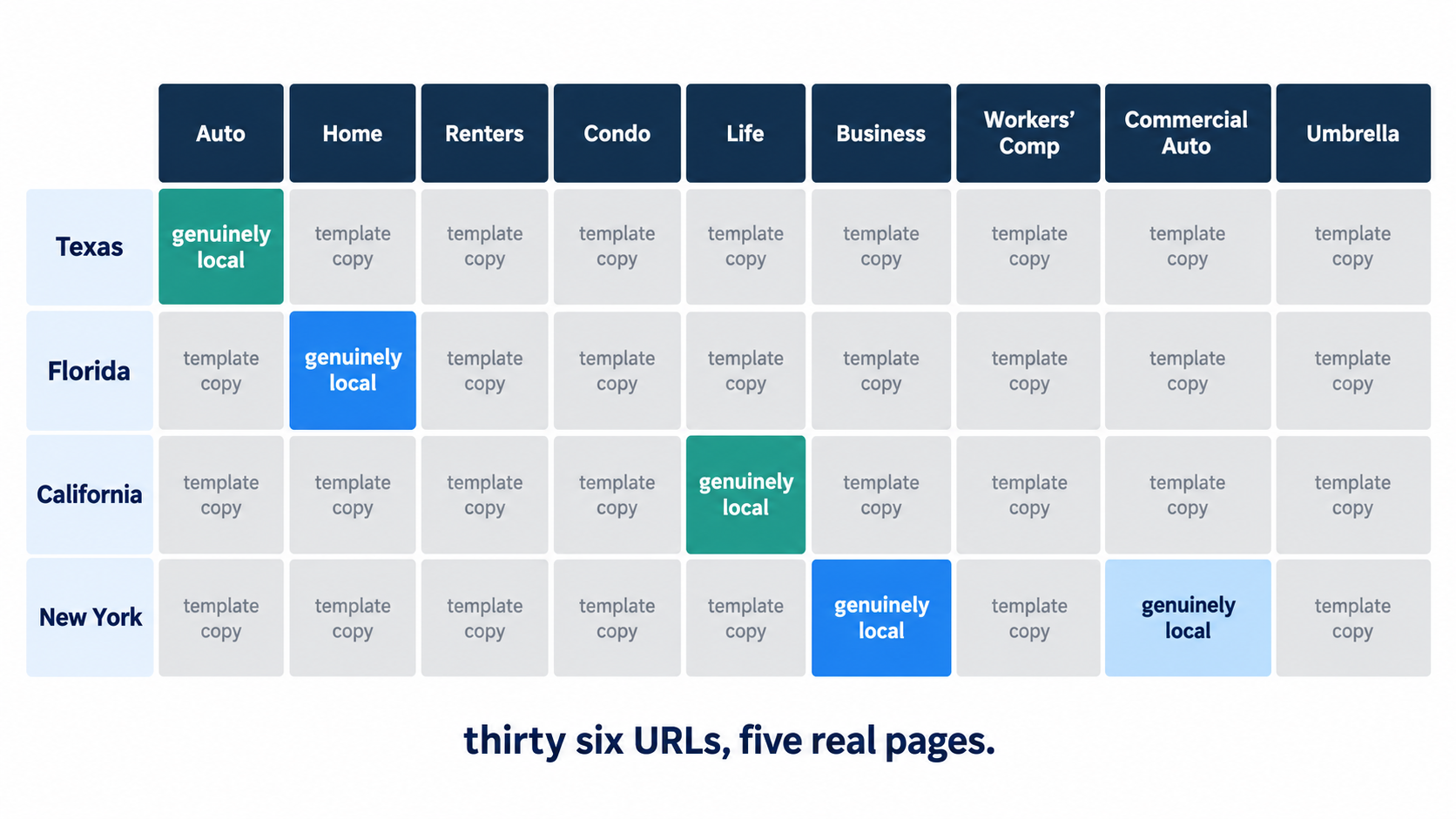
An agency writing in four states with nine lines of business has, in theory, thirty six pages it could build. Most build all of them, from a template, with the state name and the product name swapped in. Google reads those as the same page thirty six times over, and picks one, usually not the one you wanted.
The pages that survive have something local and real on them. State specific minimum coverage requirements. The carriers you actually place business with in that state. Claim timelines, local risk factors, the named agent who works that territory. If your Texas commercial auto page and your Ontario commercial auto page differ only by two words, you do not have two pages.
Agent profiles are the other common mess. Agents leave, their pages stay, and a large agency can be carrying dozens of indexed profiles for people who no longer work there. Those pages collect nothing and dilute everything. Redirect them to the relevant team or location page and be done with it.
On markup, Google’s LocalBusiness guidance is worth following precisely. Name and address are required, and Google notes that “the more properties you provide, the higher quality the result is to users” (Google Search Central). For a multi branch agency, each office gets its own page and its own markup, with real hours and a real phone number, not the head office line.
Quote forms, speed and the measurement you are probably missing
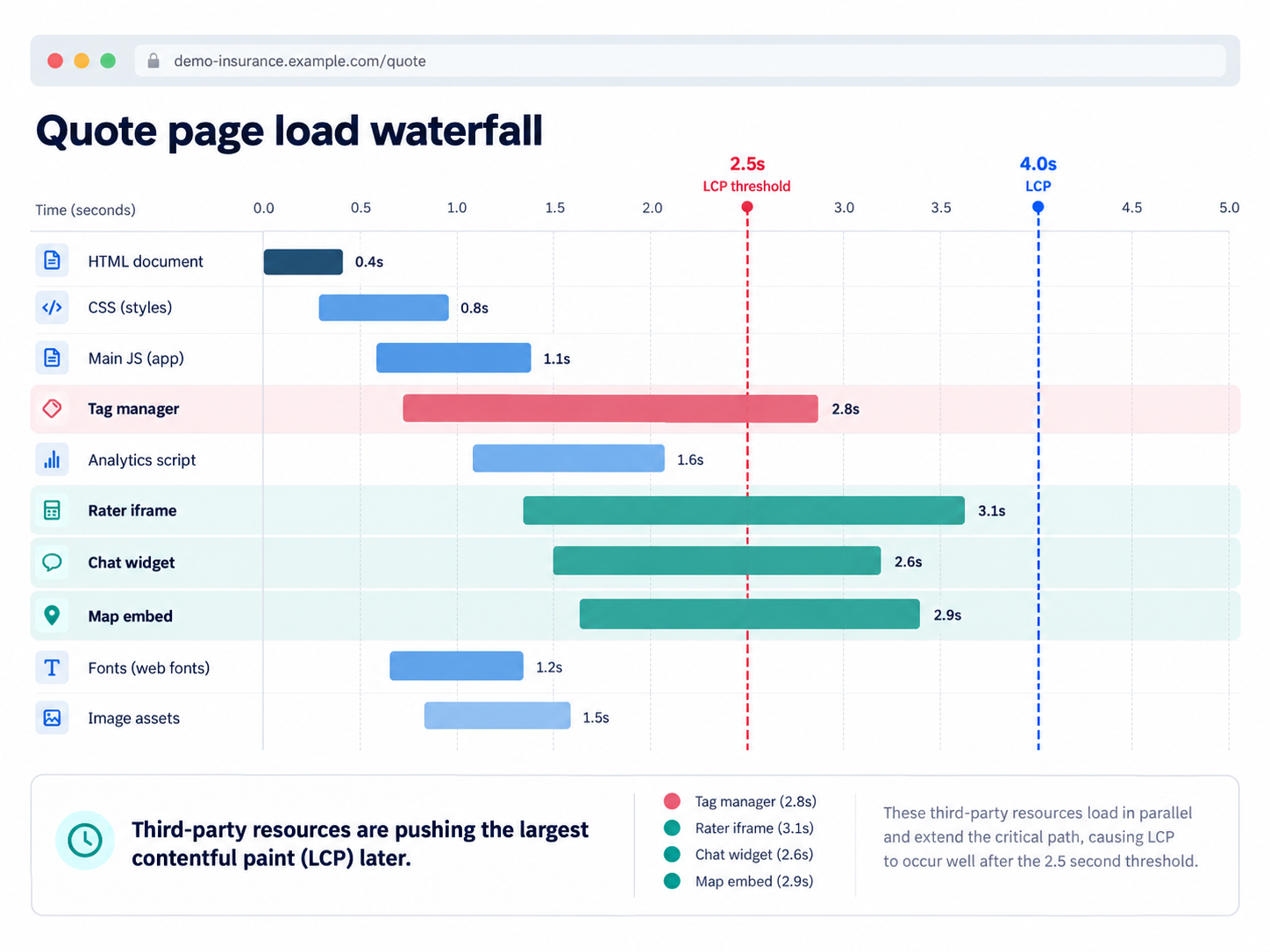
The quote form is the page that matters, and it is usually the slowest page on the site, because it loads a rater, a chat widget, two tracking scripts and a map. Google’s Core Web Vitals thresholds are specific: Largest Contentful Paint under 2.5 seconds, Interaction to Next Paint under 200 milliseconds, Cumulative Layout Shift under 0.1, measured at the 75th percentile of real visits..
That last part is the one people miss. It is real users on real phones, not a lab test on your office wifi. Pull your field data from the Core Web Vitals report in Search Console rather than a one off PageSpeed score.
The measurement side deserves its own attention because insurance is a phone driven business. If a third of your enquiries arrive as calls and you are not tracking which page and which channel produced them, your reporting is fiction. Dynamic number insertion handles this, but it has to be implemented so the displayed number stays consistent with the number in your structured data and your business profile, or you create a different problem.
A compliance note worth raising early. Insurance advertising is regulated at the state level in the US and provincially in Canada, and rules on comparative claims, guarantees and testimonials vary. Anything a technical vendor proposes that involves generating pages at scale, or pulling in review content automatically, should be reviewed by whoever handles your compliance before it ships. Flag it early; it is much cheaper than unwinding it.
How to tell a real provider from a checklist vendor

Four questions do most of the sorting.
Ask what they found on your site before they quote. Anyone serious will have crawled it, and will be able to name a specific problem. A proposal that could have been sent to any insurance agency was sent to any insurance agency.
Ask who does the implementation. A great deal of technical SEO dies in a queue because the agency writes recommendations and your web vendor never gets to them. If the provider cannot push changes themselves, agree in writing who will and by when.
Ask what happens to your rankings during the work. Consolidating duplicate pages and pruning old agent profiles can cause a dip before it causes a gain. A provider who says there is no downside has not done this before.
Ask how success is measured. Rankings are a diagnostic, not a result. The number that matters is quote requests and calls, attributed to the pages that produced them.
What a realistic timeline looks like
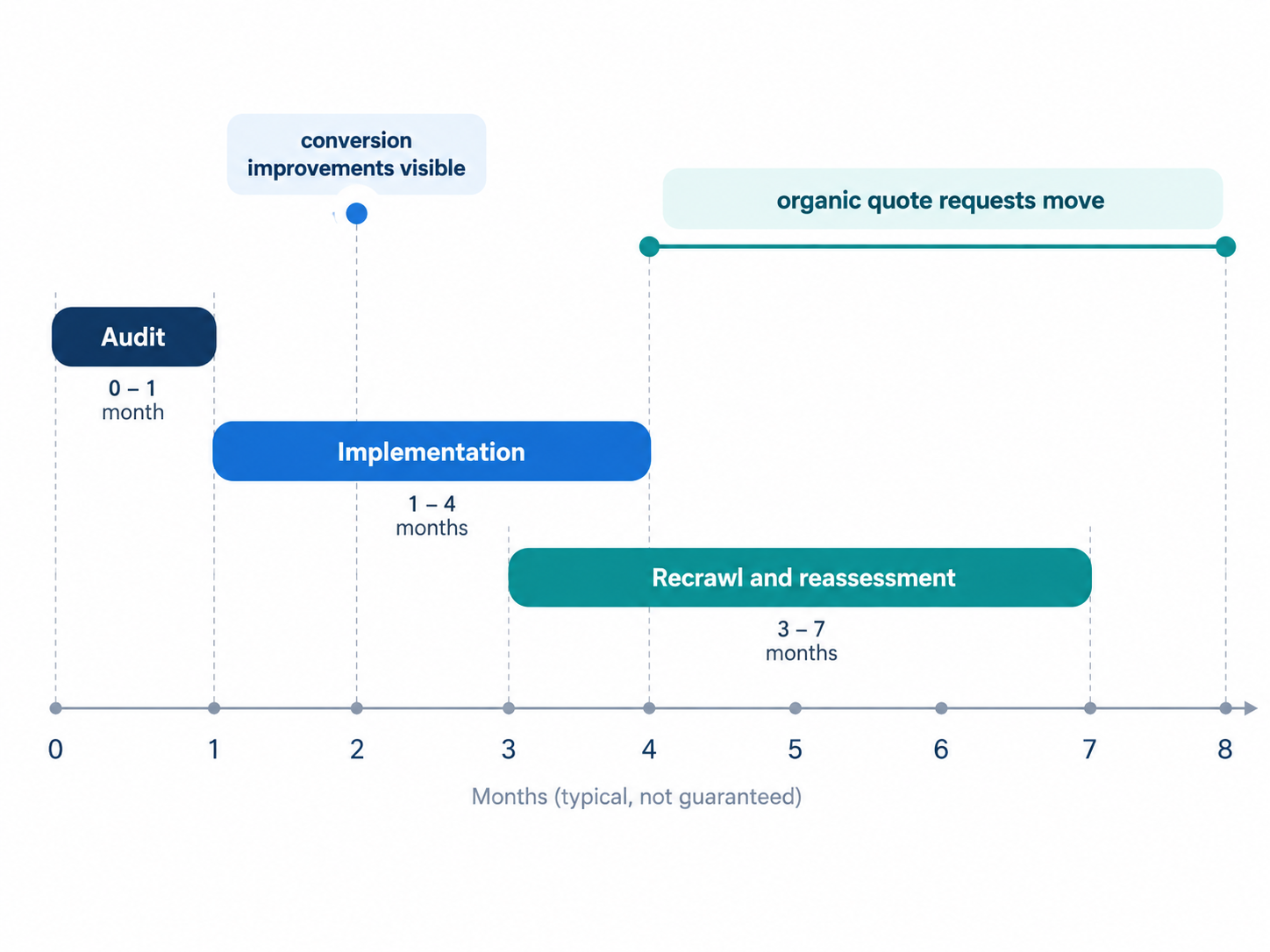
The audit and crawl take two to three weeks on a site of any size. Implementation runs six to twelve weeks depending on your platform and who owns the code. Recrawling and reassessment adds another two to three months before consolidated pages settle into their new positions.
So: measurable movement in organic quote requests somewhere between four and eight months, with speed and tracking improvements showing up much sooner because they affect conversion rather than rankings. Insurance is a competitive, well funded search category and nobody is going to outrank a national carrier on “car insurance” with a technical audit. The realistic win is local and product specific terms, plus getting more out of the traffic you already have.
If you want to know what is actually wrong with your site before you commit to anyone, we run technical audits for insurance agencies and brokerages in the US and Canada, and we will tell you if the work is not worth doing yet.