A service page that held position four for a year is sitting at seven on Thursday morning, and the phone is ringing. Someone on the team wants to rewrite the title tag before lunch. Don’t let them. (The page is made up. The reflex isn’t.)
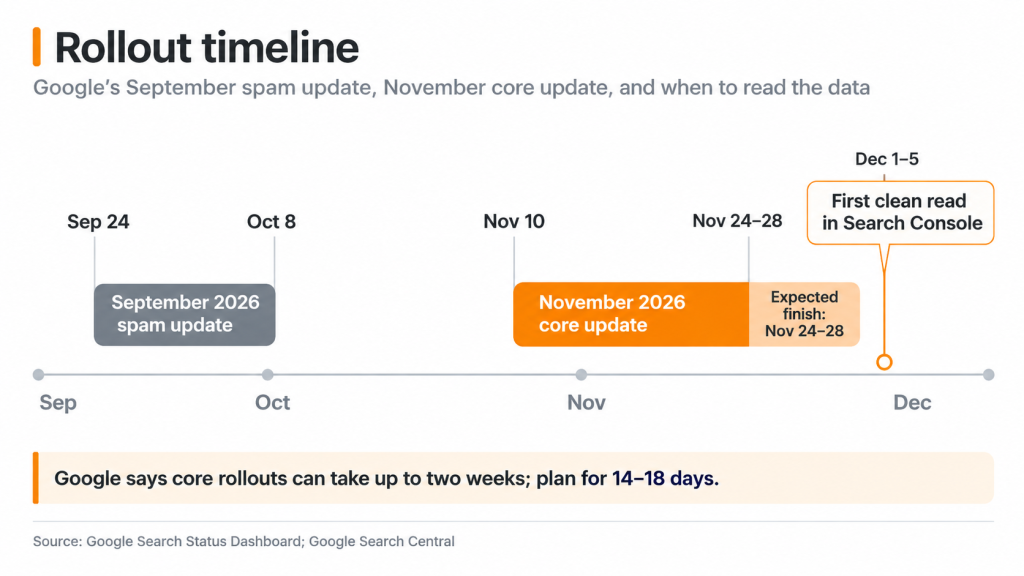
Google began rolling out the November 2026 core update on November 10 at 10:06 a.m. Pacific, the third core update of the year. Google says it will take up to two weeks. Plan for 14 to 18 days, which puts the finish between November 24 and 28, and expect rankings and AI citations to bounce around until then.
When organic traffic dips mid-rollout, teams reach for something visible. They rewrite title tags, prune blog posts, rework internal links. That reflex costs twice: once in development hours, and again when it breaks pages Google hadn’t finished recalculating.
Why edits during the rollout cost you twice
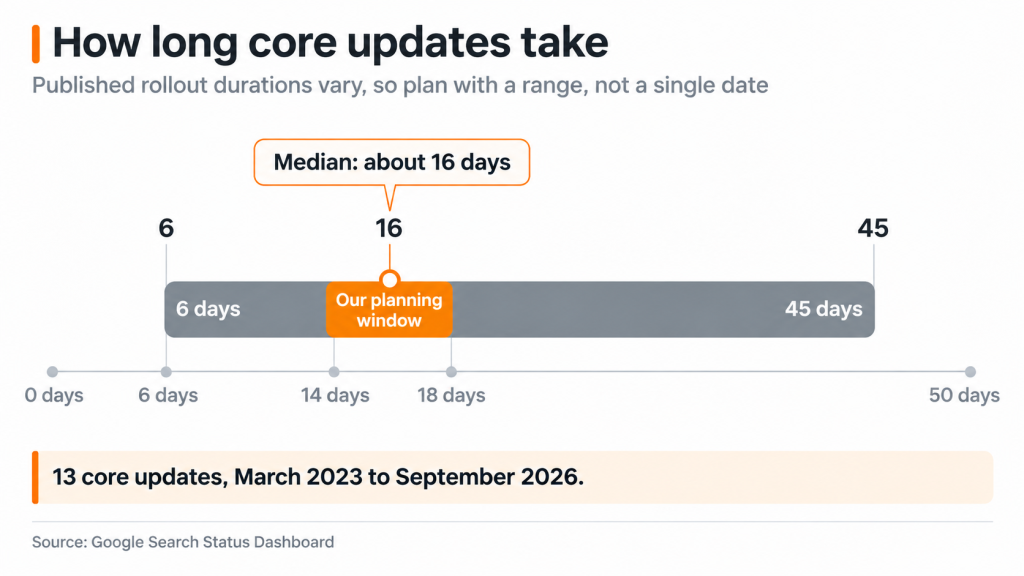
A core update isn’t a switch that flips at 10:06 on a Tuesday. It’s a staggered recalculation across several ranking systems, and two weeks is only an estimate. Google’s Search Status Dashboard lists 13 core updates between March 2023 and September 2026. Their rollouts ran from six to 45 days, with a median of about 16.
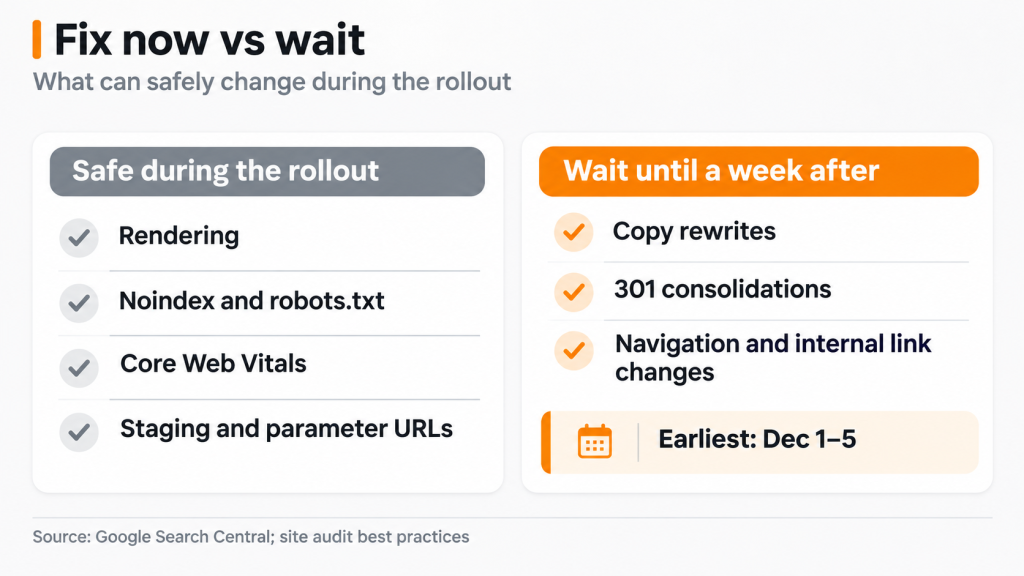
Google Search Central tells site owners not to make reactive changes during a rollout. Its documentation recommends waiting at least a full week after the rollout ends before drawing conclusions in Search Console. Counting from the 14-to-18-day window, that puts your first clean read between December 1 and 5.
The reason is measurement. Rewrite copy, consolidate URLs or strip out internal links while Google’s systems are still recalibrating, and you’ve added a second variable to a moving experiment. If rankings are still down in December, you won’t know whether the update demoted the site or your mid-November edit broke a page that was about to bounce back. Use the two weeks for diagnosis instead.
Rule out the September spam update first
Check the calendar first. Some of the lead slowdown Canadian and US firms are seeing now is fallout from Google’s September 2026 spam update, which finished rolling out on October 8 after 13 days, 15 hours and 45 minutes. B2B and legal sales cycles run long, so a ranking drop in early October often doesn’t reach the pipeline report until mid-November.
That update carried weight because of a policy change in the spring. On May 15, 2026, Google added attempts to manipulate generative AI responses, including AI Overviews and AI Mode, to its spam policies. Scaled content abuse and manufactured citation bait now draw both manual actions and algorithmic demotions.
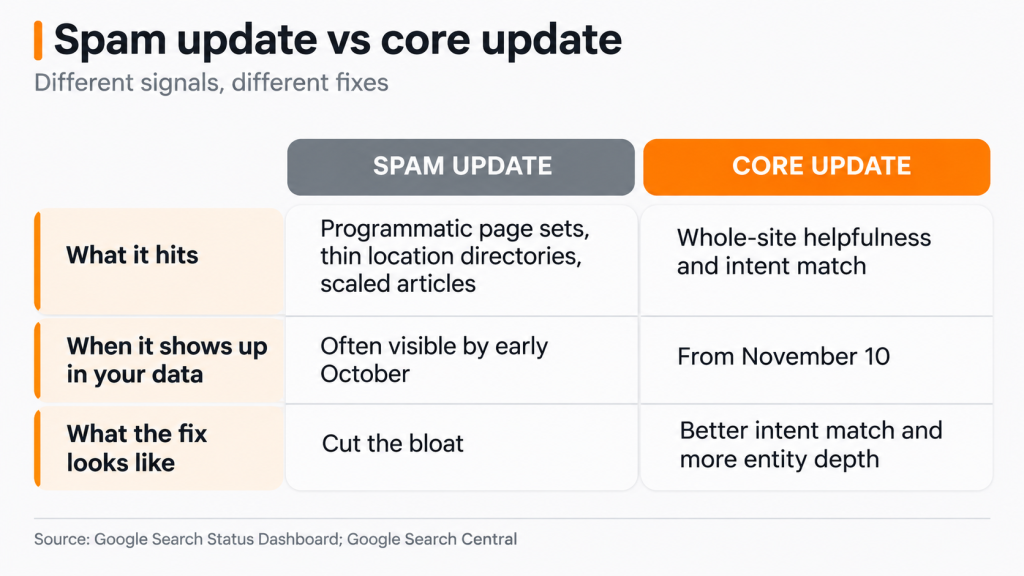
The two updates leave different marks in your data. Spam enforcement hits programmatic page sets and thin location directories, plus scaled low-value articles and manufactured AI citation bait, mostly around early October. The core update re-evaluates helpfulness and intent match across the whole site from November 10. The fixes point in opposite directions: a core slip calls for better intent match and more entity depth, and a spam demotion calls for cutting the bloat. Treat one as the other and you’ll fix the wrong thing.
Five steps for auditing the drop
You don’t need a paid volatility tracker. You need clean date boundaries and first-party data, and every step below works while the rollout is still running.
Pull two baselines in Search Console
Set your primary baseline to the full week ending November 9, the last clean week before the rollout. Pull a second window for the week before October 8 and compare both against current data. A page already down by October 8 points to the spam update, while a page that held until November 10 points to the core update.
Segment by template and query type
Site-wide rank trackers average the problem away. Export your Search Console performance data and group URLs by template: core service pages, regional location pages, product directories and informational blog posts. Then split branded queries from non-branded buyer queries, because a drop on a high-volume glossary page can hide steady performance on the commercial pages that bring in leads.
Apply Google's position threshold
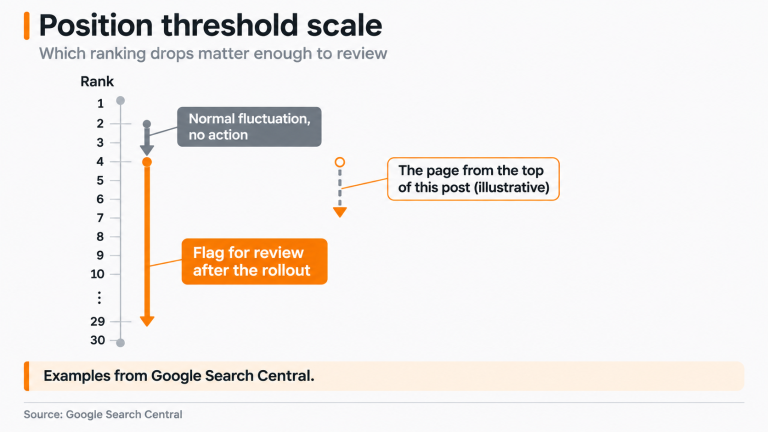
Not every red arrow deserves a meeting. Google’s core update guidance treats a slip from position 2 to position 4 as a small fluctuation that needs no action. A fall from position 4 to position 29 is a different matter, so flag drops that size for a full review of helpfulness and intent match once the rollout ends. The page from the top of this post, four to seven, sits closer to the first case than the second.
Separate ranking losses from AI Overview compression
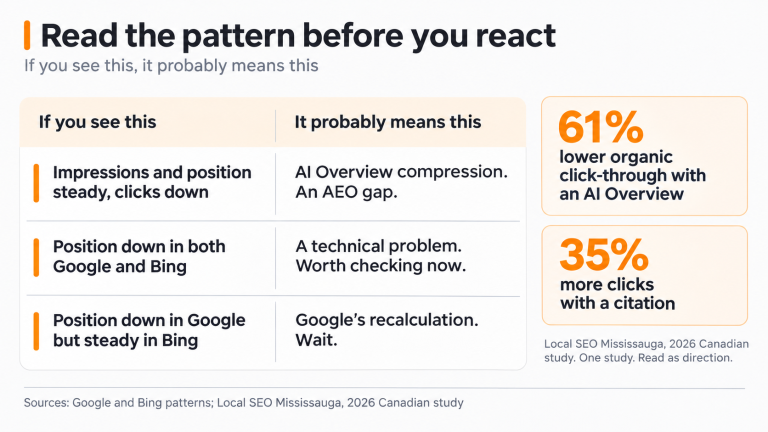
Look at impressions and average position next to clicks. If the first two held after November 10 and clicks fell anyway, you probably don’t have a core update problem. You have an answer engine optimization (AEO) gap. A 2026 Canadian study by Local SEO Mississauga found that AI Overviews cut organic click-through rates by 61%, and that a citation inside the overview lifted organic clicks by 35%. It’s one study, so read it as direction rather than a forecast. We covered the split in why Google rankings stopped predicting AI mentions: ranking in the top ten and earning the citation are now separate jobs.
Cross-check Bing Webmaster Tools
Google held 85.3% of Canadian search across all platforms in September 2026, and Microsoft Bing held 10.06% (Statcounter, via DLR Media). Bing is small, but it works as a control group. Open Bing’s AI Performance and traffic reports and compare desktop rankings and clicks. If they’re steady in Bing while Google moves, the site probably doesn’t have a rendering or indexing failure. It’s riding out Google’s recalculation.
What you can fix now and what has to wait
Waiting doesn’t mean ignoring real faults. Mechanical problems are safe to fix mid-rollout because they change what Google can read, not what it thinks of your content. Look for server-side rendering that leaves marketing copy out of the initial HTML, accidental noindex tags or an over-broad robots.txt block from a recent deploy, slow Core Web Vitals on service and intake templates, and indexed staging subdomains or duplicate parameter URLs.
Anything that changes what the site says waits until a full week after the rollout ends: rewritten headlines and body copy on established money pages, or content consolidated with 301 redirects. Navigation and internal link changes wait too.
Technical fixes can register within a few weeks, because you’ve changed what the crawler can reach. Recovery from a genuine core update reassessment means rebuilding topical depth and generative engine optimization (GEO) structure, and that usually takes a full quarter or until the next core update. Anyone promising a seven-day turnaround is guessing.
Where Canopy fits
If you’d like someone else to read your Search Console and AI citation data before anyone touches the site, we can run that diagnosis. We’ll sort the drops that are noise from the ones that need a plan, and tell you which fixes can ship this week and which have to wait until the first week of December.