Most B2B companies in Houston don’t win work from strangers on Google. They win it from a project manager at an EPC firm who remembers them from the last turnaround, or from a conversation on the floor at the Offshore Technology Conference at NRG Park. So when an agency promises more traffic, the owner nods politely and wonders what any of it has to do with the next pump skid order. Fair question. Usually not much, unless the agency understands who is doing the buying now and where they look first.
Your buyer has decided before they call
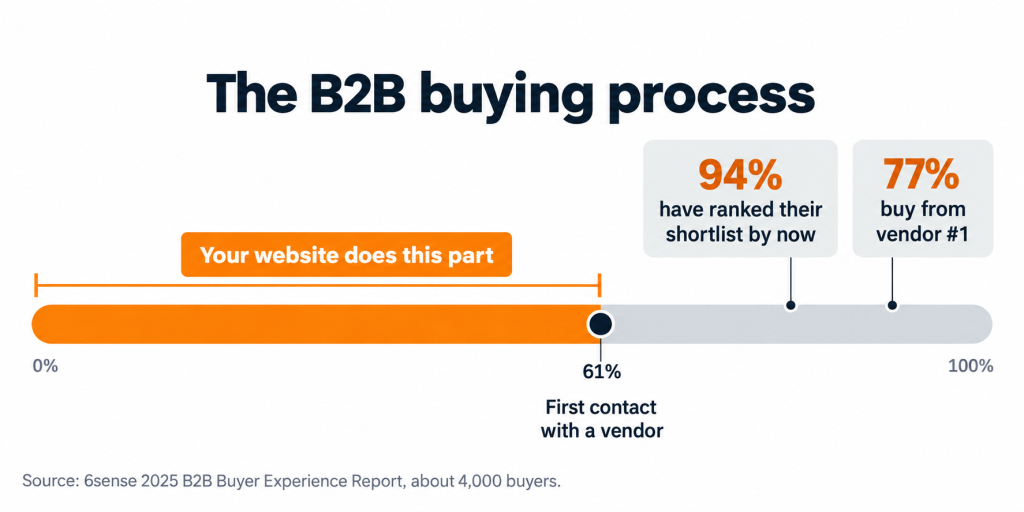
Gartner surveyed 646 B2B buyers in August and September 2025 and found that 67% would rather buy without a sales rep. The 6sense 2025 Buyer Experience Report, drawn from nearly 4,000 buyers, adds the uncomfortable part. Ninety-four percent had ranked their shortlist before contacting any vendor. They bought from whoever sat at the top of that list 77% of the time, and first contact came, on average, 61% of the way through the process.
That changes what your website is for. It isn’t a brochure that backs up your sales team; for most of the buying process it is the sales team, and it’s being judged by an engineer and a procurement lead who will never tell you they visited.
Houston B2B buyers have their own habits
Business services is now Houston’s largest employment cluster (13.5% of local jobs, per the Dallas Fed), but energy still sets the rhythm. As of 2025, 19 of the metro’s 26 Fortune 500 headquarters were energy related.
That mix makes for an unusual buyer. Cycles run long (6sense puts the North American average at 11.1 months). The committee pairs an engineer who reviews the specs with a procurement lead who reviews everything else, and HSE can veto both. Demand moves with the price of oil, so many of your best prospects spend long stretches not buying anything.
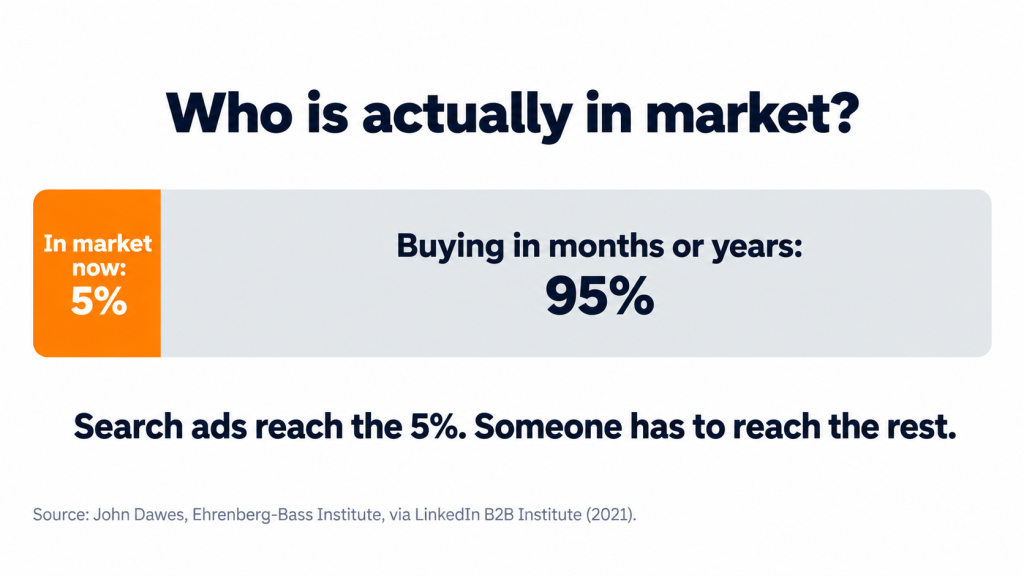
This is where generalist agencies go wrong. In research published with the LinkedIn B2B Institute in 2021, John Dawes of the Ehrenberg-Bass Institute estimated that only about 5% of B2B buyers are in the market at any given time, and the other 95% won’t buy for months or years. An agency that only runs search ads to people ready today is fishing in the 5% pond alongside every competitor on the Ship Channel. Somebody has to keep your name in front of the other 95%, so it’s the one they remember when a capex budget finally gets approved.
Fix the website before you buy more traffic
Start with the website, because that’s where the shortlist gets decided. If a buyer can’t find your lead times, your certifications, a spec sheet and at least a price range without filling in a form, you’re losing quotes to the competitor who published theirs. Industrial companies hate this advice. Published pricing feels like giving the game away, but the buyer who can’t find it doesn’t call to ask. They open the next tab.
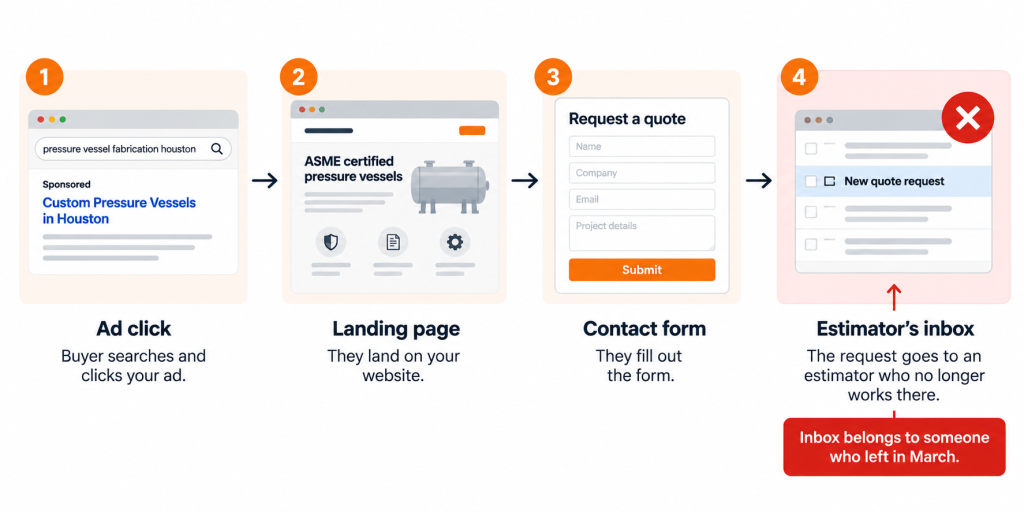
Picture a fabrication shop in Pasadena that builds pressure vessels for midstream operators. Its site has an ASME logo and a contact form. The agency has run Google Ads on “pressure vessel fabrication Houston” for a year and reports a healthy click-through rate. Nobody has checked that the form still emails an estimator who left in March, or that half the clicks come from phones in Katy belonging to welders looking for work. Fixing the form routing and adding a negative keyword list would do more for that shop in a week than another year of the same spend. (The shop is made up. The pattern isn’t.)
Tracking comes next, and it has to reach your CRM. Form fills and calls should land in HubSpot or Salesforce with their source attached, so you can see which channel produced the RFQs that turned into purchase orders. An agency that reports impressions and “engagement” to an industrial supplier is measuring the wrong end of the funnel.
Want to see where you sit on a buyer’s shortlist? We’ll compare your search, ads, reviews and website against your five main competitors and show you which gaps are costing you RFQs.
Industrial buyers scroll past the ads
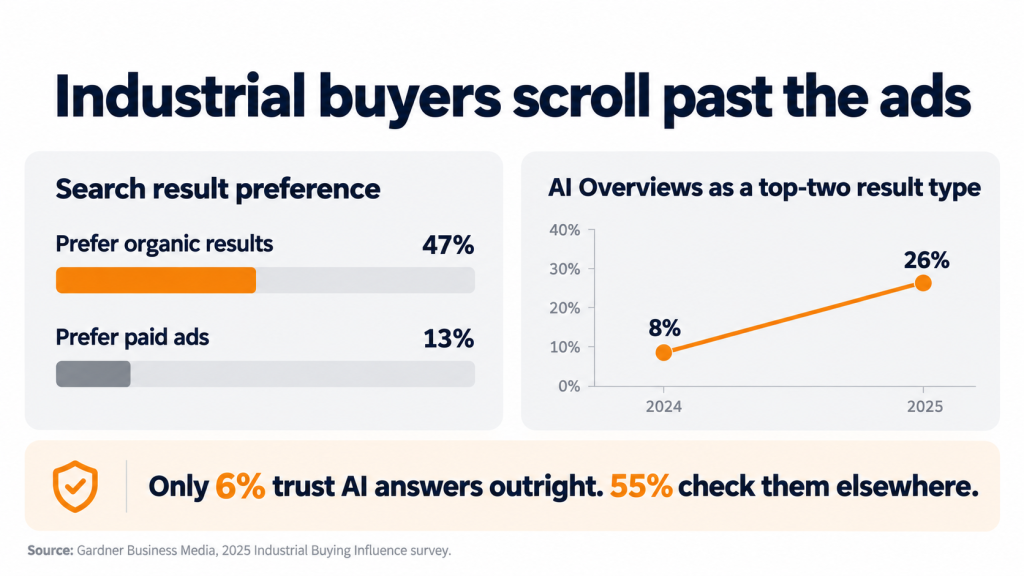
Gardner Business Media’s 2025 Industrial Buying Influence survey of manufacturing buyers found that 47% prefer unpaid organic results when they search, against 13% who prefer paid ads. AI Overviews are climbing fast: 26% named them one of their two preferred result types in 2025, up from 8% the year before. Trust is another matter. Only 6% take an AI answer at face value, and 55% check it against other sources.
LinkedIn ads still earn their place when you’re targeting a named list of accounts, and email keeps you in front of the 95% between projects. But the mix depends on your buyer. An agency that pitches the same package to a valve distributor and a software startup hasn’t looked at either one.
Four questions for the first meeting
- Which of your current clients sell to engineers or procurement teams?
- How will you connect our form fills and calls to closed deals in our CRM?
- Who owns the ad accounts, analytics and website if we part ways?
- What would you switch off first?
The last one tells you the most. A proposal that only adds channels, and never suggests dropping the trade magazine ad you’ve renewed out of habit for six years, is a sales document.
Marketers and developers on one team
That second question is the one we’d most like to be asked, because having our own developers changes the answer. When a Canopy strategist finds RFQs arriving in HubSpot with no source attached, or a spec sheet that won’t open on a phone, the fix goes to a developer on our team in Texas or Ontario rather than a subcontractor’s ticket queue. Most of what this article recommends is development work with a marketing label on it. It moves faster when nobody has to translate between two companies.
Conversion fixes can show up in weeks. Organic rankings for a term like “pressure vessel fabrication Houston” take two or three quarters to move, and we’ll say so in the proposal.
To start, book a strategy session. Bring the search terms report from your Google Ads account and a note of where your last ten RFQs came from. If you don’t know, that’s the first thing we’ll fix.