Why Physicians in Houston Need SEO More Than Ever
| Stage | Example Search |
|---|---|
| Symptoms | Why am I having chest pain |
| Research | Best treatment for chest pain |
| Provider Search | Cardiologist Houston |
| Comparison | Best cardiologist near me |
| Appointment | Schedule cardiology consultation |
Houston is home to one of the most competitive healthcare markets in North America. With the Texas Medical Center, hundreds of specialty clinics, independent physician practices, urgent care centers, and multi location healthcare organizations competing for patient attention, visibility on Google has become a critical growth factor.
Today, the patient journey begins long before a phone call or appointment request. Patients search symptoms, treatment options, physician reviews, insurance acceptance, office locations, and provider credentials online before making a healthcare decision.
If your practice does not appear when patients search for services you provide, those appointments are going to competitors.
This is why investing in the best SEO for physicians in Houston is no longer optional. It is one of the most effective ways to consistently attract qualified patients, build trust, and reduce dependence on paid advertising.
What Makes Physician SEO Different?
Healthcare SEO is fundamentally different from traditional SEO.
Google applies stricter quality standards to medical websites because healthcare content can directly impact patient wellbeing. Medical websites fall under what Google refers to as Your Money Your Life content, meaning expertise, authority, and trustworthiness are critical ranking factors.
Successful physician SEO requires:
- Medical content written with accuracy and expertise
- Strong physician credential signals
- HIPAA conscious marketing practices
- Local SEO optimization
- Technical website performance
- Reputation management
- Structured medical schema implementation
Many agencies can improve rankings. Few understand how patients search for healthcare services and what Google expects from medical websites.
Why Local SEO Drives Patient Acquisition
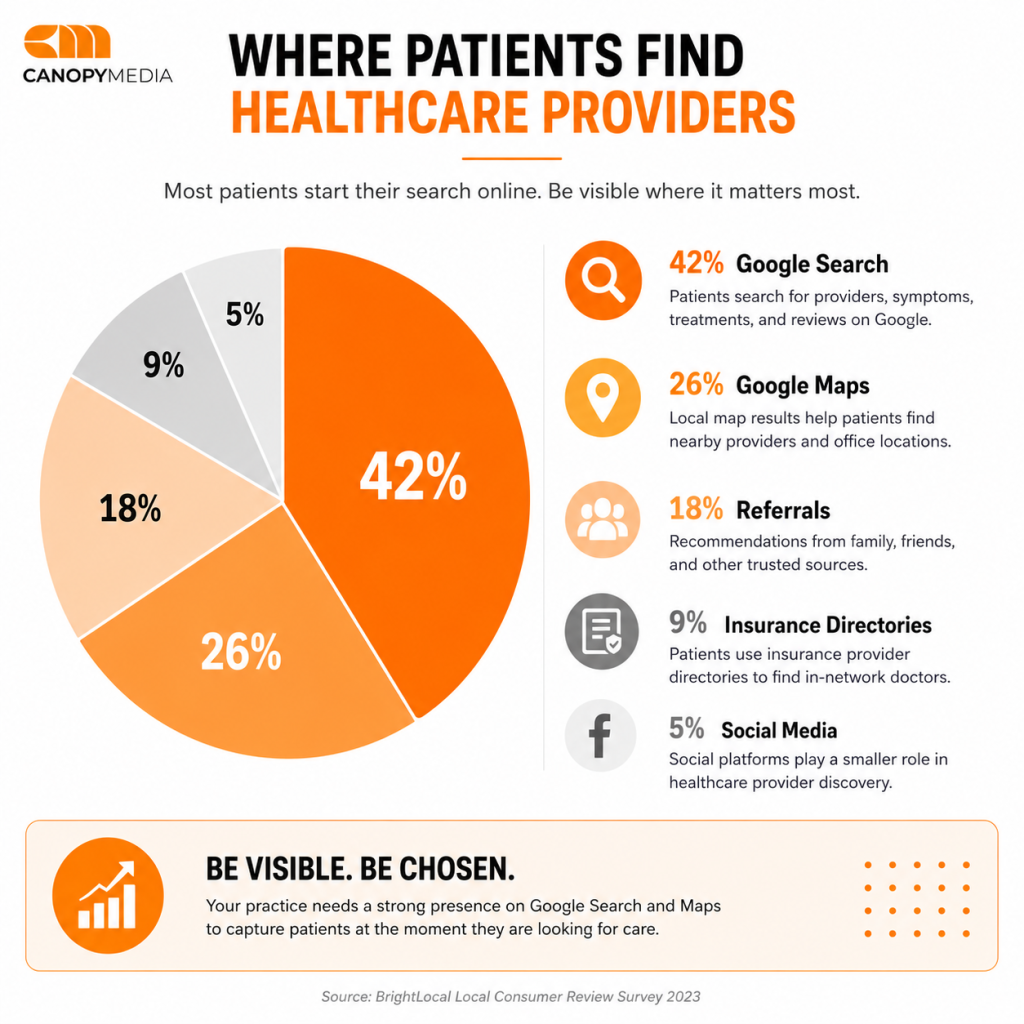
Most healthcare searches have local intent.
Patients are rarely looking for a physician across the country. They are searching for providers nearby.
Common searches include:
- Family doctor Houston
- Cardiologist near me
- Pediatrician in Katy TX
- Orthopedic surgeon Houston
- Dermatologist accepting new patients
Google prioritizes local results because proximity plays a significant role in healthcare decision making.
Average Patient Search Behavior
| Search Activity | Percentage |
|---|---|
| Search online before booking | 77% |
| Read physician reviews | 72% |
| Use Google Maps during research | 68% |
| Visit multiple provider websites | 63% |
| Book with providers appearing on page one | 92% |
For Houston physicians, local SEO often produces the highest return because it targets patients actively looking for care.
The Five Core Components of Medical SEO Success
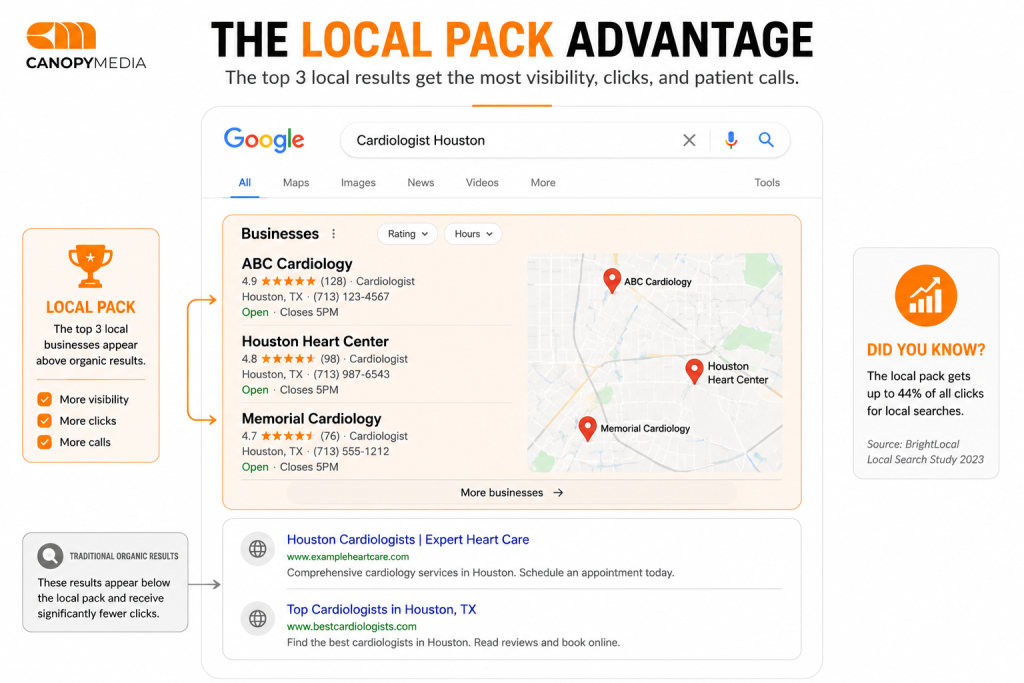
1. Google Business Profile Optimization
Your Google Business Profile often generates more patient interactions than your website itself.
An optimized profile includes accurate contact information, appointment links, physician photos, service categories, office hours, and patient reviews.
For practices serving multiple Houston neighborhoods such as The Woodlands, Katy, Sugar Land, Pearland, and Memorial, geographic relevance becomes a major ranking factor.
2. Healthcare Focused Content Strategy
Patients search questions before they search providers.
A patient experiencing knee pain may first search:
“Why does my knee hurt when climbing stairs?”
Only later will they search:
“Orthopedic specialist Houston”
This creates an opportunity for physicians to build trust before a patient begins evaluating providers.
High performing medical content includes symptom guides, treatment explanations, condition resources, preventative care information, and frequently asked questions.
3. Technical SEO
Medical websites must perform exceptionally well on both desktop and mobile devices.
Google evaluates factors such as:
| Technical Factor | Impact on Rankings |
|---|---|
| Crawlability | High |
| Indexing | High |
| Site Speed | High |
| Mobile Usability | High |
| Core Web Vitals | High |
| HTTPS Security | Essential |
| Schema Markup | High |
A technically optimized website improves both rankings and patient experience.
4. Online Reputation Management
Patient reviews significantly influence both search rankings and patient decisions. Read more.
Many patients compare multiple providers before choosing one.
A physician with 150 reviews and a 4.9 star rating will generally outperform a competitor with 15 reviews, even if both rank similarly.
Review acquisition strategies should become part of every physician’s growth plan.
5. Local Authority Building
Google evaluates authority through mentions, citations, backlinks, physician profiles, healthcare directories, and local relevance.
Healthcare specific directories such as Healthgrades, WebMD, Zocdoc, Vitals, and local medical associations help strengthen authority signals while improving patient discovery.
Why Ranking Position Matters
Many physicians underestimate how much traffic is concentrated at the top of search results.
Moving from position five to position one does not create a small increase in visibility. It can create several times more website traffic.
Average Click Through Rate by Ranking Position
| Position | Average CTR |
|---|---|
| #1 | 27.6% |
| #2 | 15.8% |
| #3 | 11.0% |
| #4 | 8.4% |
| #5 | 6.3% |
A first position ranking can generate more than four times the traffic of a fifth position ranking for the same keyword.
This is why physician SEO focuses on improving rankings for high value service and location based searches.
What Results Can Physicians Expect?
SEO is a long term growth channel, not an overnight solution.
However, practices that invest consistently often experience substantial gains.
Typical Organic Growth Timeline
| Time Period | Expected Outcome |
|---|---|
| Month 1 to 2 | Technical improvements and optimization |
| Month 3 to 4 | Improved rankings and local visibility |
| Month 5 to 6 | Increased website traffic |
| Month 6 to 12 | Growth in patient inquiries and appointments |
As authority increases, SEO often becomes one of the lowest cost patient acquisition channels available.
SEO vs Paid Advertising for Physicians
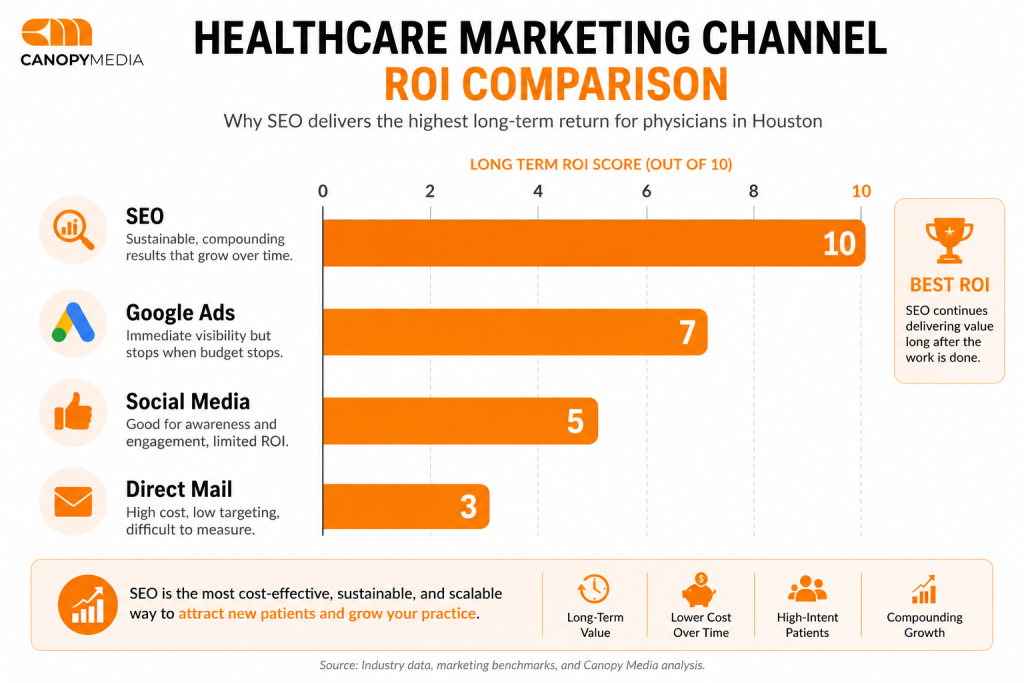
Many healthcare providers rely heavily on paid advertising.
While paid ads can generate immediate visibility, traffic disappears as soon as the budget stops.
SEO continues generating value long after optimization efforts are completed.
Patient Acquisition Channel Comparison
| Channel | Lead Quality | Long Term ROI | Sustainability |
|---|---|---|---|
| SEO | Excellent | Excellent | High |
| Google Ads | High | Moderate | Low |
| Social Media | Moderate | Moderate | Moderate |
| Direct Mail | Low | Low | Low |
For most physician practices, SEO becomes the foundation of sustainable patient growth.
Choosing the Best SEO Partner for Physicians in Houston
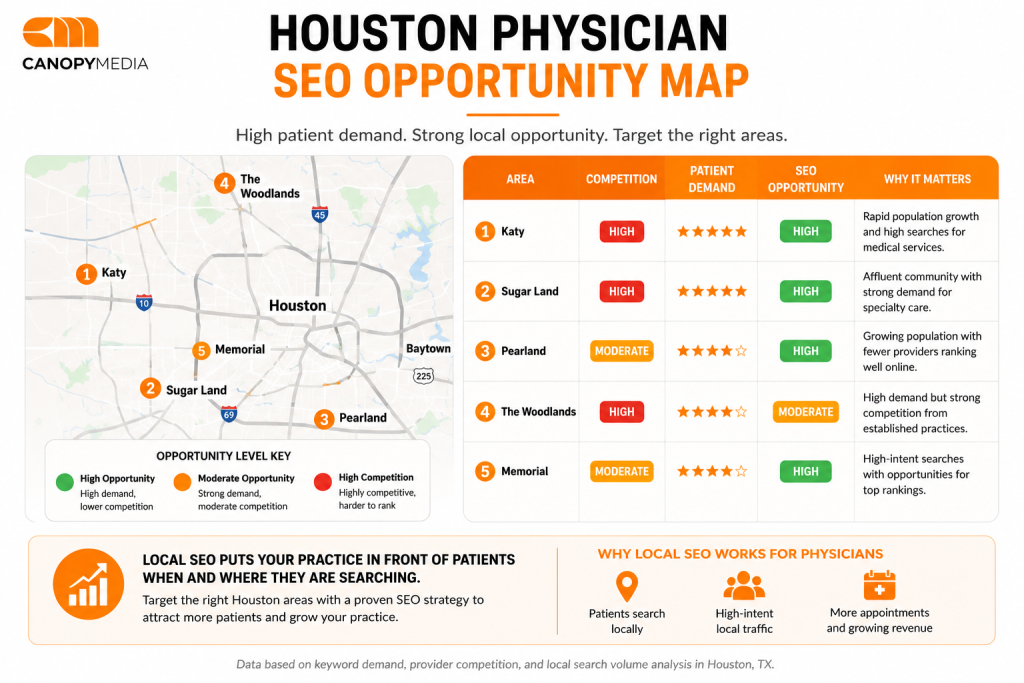
The best SEO for physicians in Houston combines healthcare expertise, technical excellence, local search optimization, and a deep understanding of patient behavior.
A successful SEO strategy should help your practice:
- Increase visibility across Houston neighborhoods
- Rank for high intent healthcare searches
- Generate more appointment requests
- Improve online reputation
- Strengthen physician authority
- Reduce patient acquisition costs
Most importantly, it should connect your practice with patients actively searching for the care you provide.
Ready to Grow Your Medical Practice?
Whether you are a family physician, cardiologist, orthopedic surgeon, dermatologist, pediatrician, dentist, or multi location healthcare organization, a tailored SEO strategy can transform your online visibility and patient acquisition efforts.
Discover how your practice currently performs in search, identify missed patient acquisition opportunities, and receive a customized growth roadmap designed specifically for Houston’s healthcare market.