Houston has quietly become one of the most competitive ecommerce markets in the United States.
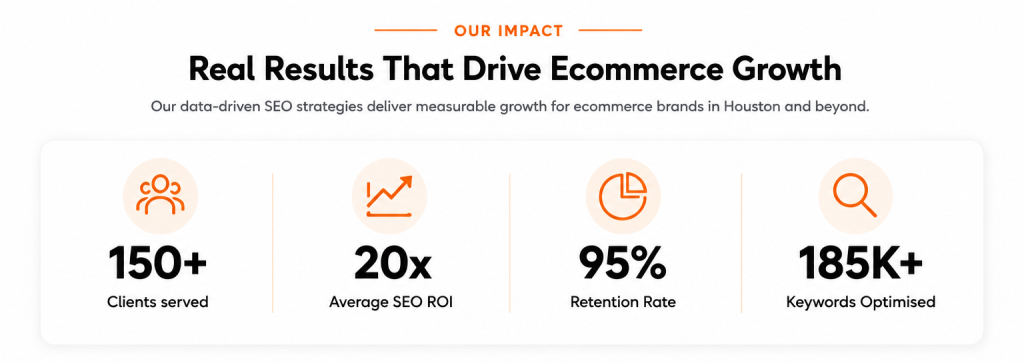
As more businesses shift online and customer acquisition costs continue rising across paid advertising platforms, ecommerce brands are investing more aggressively into SEO to create sustainable growth. From fashion and industrial supply stores to health products, furniture brands, beauty companies, and B2B ecommerce businesses, competition in search results has intensified dramatically over the last few years.
Today, ranking well in Google is no longer simply about adding keywords to product pages.
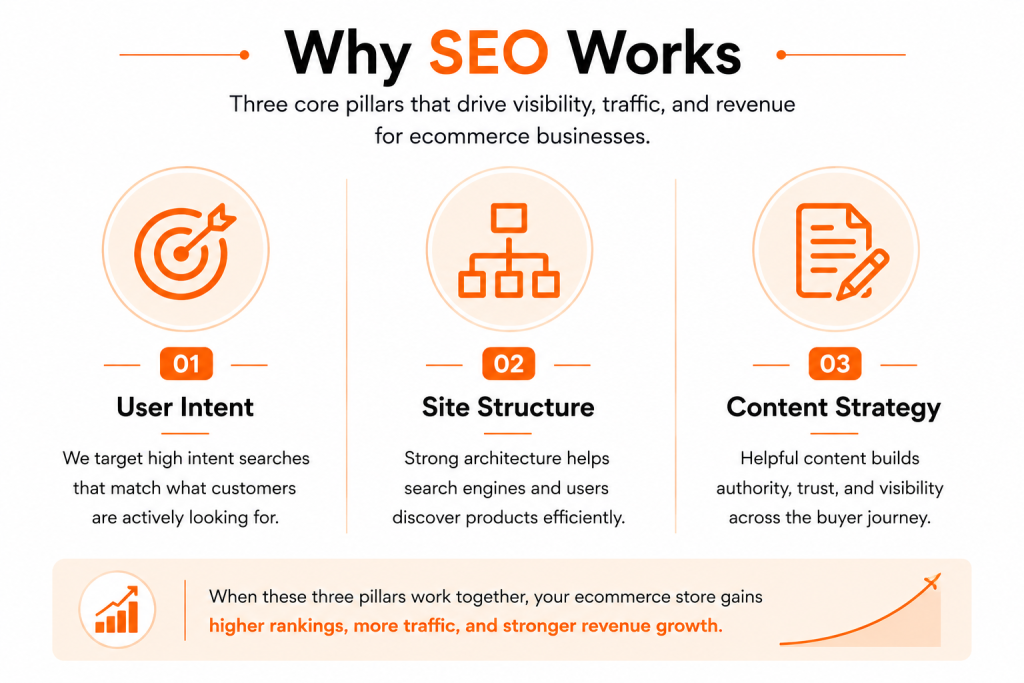
Modern ecommerce SEO is deeply tied to user experience, technical performance, search intent, content quality, site structure, authority, and conversion optimization. This is exactly why many businesses searching for a Houston Ecommerce SEO Company are no longer looking for generic SEO packages. They are looking for strategic partners that understand how ecommerce growth actually works.
The businesses winning in search today are building systems designed around visibility, customer trust, and long term acquisition rather than chasing short term ranking tricks.
Why Ecommerce SEO Matters More Than Ever
Paid advertising costs have increased substantially across Google Ads, Meta, and shopping campaigns over the past several years.
Many ecommerce brands that once relied heavily on paid traffic are now facing shrinking margins as cost per click rates continue climbing. In competitive product categories, some brands are paying several dollars per click before even generating a sale.
SEO changes that equation.
A strong ecommerce SEO strategy creates long term visibility that continues generating traffic without paying for every visitor individually. Unlike paid ads that disappear the moment budgets stop, organic rankings compound over time as authority and trust increase.
This matters especially in ecommerce where customer acquisition costs directly impact profitability.
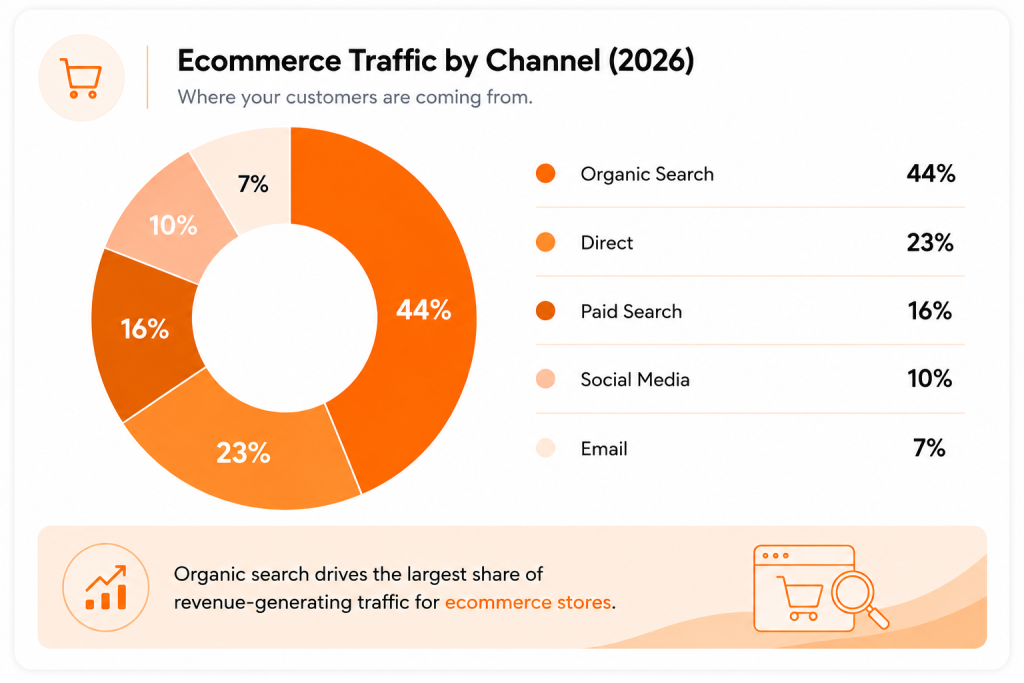
According to industry ecommerce benchmarks, organic search consistently remains one of the highest converting acquisition channels for many online stores because users are actively searching with intent. Someone searching for a specific product, comparison, or solution is already far closer to purchasing than a passive social media user casually scrolling content.
That intent is what makes ecommerce SEO so valuable.
Why Most Ecommerce Websites Struggle to Rank
One of the biggest misconceptions about ecommerce SEO is that product pages alone are enough to compete.
In reality, many ecommerce websites fail because they rely too heavily on thin product descriptions, duplicate manufacturer content, poor technical structure, and weak category organization.
Google has become significantly more sophisticated at evaluating content quality and overall site usefulness.
An ecommerce website with thousands of products but very little supporting information often struggles to build authority. On the other hand, stores that create educational content, buying guides, category level optimization, FAQs, and comparison resources tend to perform much better over time.
This is especially important after recent Google algorithm updates that increasingly reward experience, expertise, and user value.
A Houston Ecommerce SEO Company today must think far beyond rankings alone. The strategy needs to consider:
- Site architecture
- Mobile usability
- Conversion optimization
- Page speed
- Internal linking
- Product discoverability
- Category structure
- Search intent
- Content depth
- Authority signals
These factors work together.
Strong ecommerce SEO is rarely about one isolated tactic.
Houston Is Becoming a Major Ecommerce Growth Market
Houston’s business environment makes it uniquely attractive for ecommerce growth.
The city has strong logistics infrastructure, a large consumer base, expanding industrial sectors, and increasing digital adoption across both B2C and B2B industries. Ecommerce businesses in Houston are no longer competing only locally. Many are competing nationally.
That creates both opportunity and pressure.
A local ecommerce brand selling products online may now compete against national retailers, Amazon listings, marketplace sellers, and heavily funded direct to consumer brands.
To survive in that environment, visibility matters.
The businesses dominating search today are not necessarily the largest companies. Often, they are the businesses that invested early into SEO, content strategy, and technical optimization while competitors focused only on advertising.
Technical SEO Is the Foundation of Ecommerce Growth
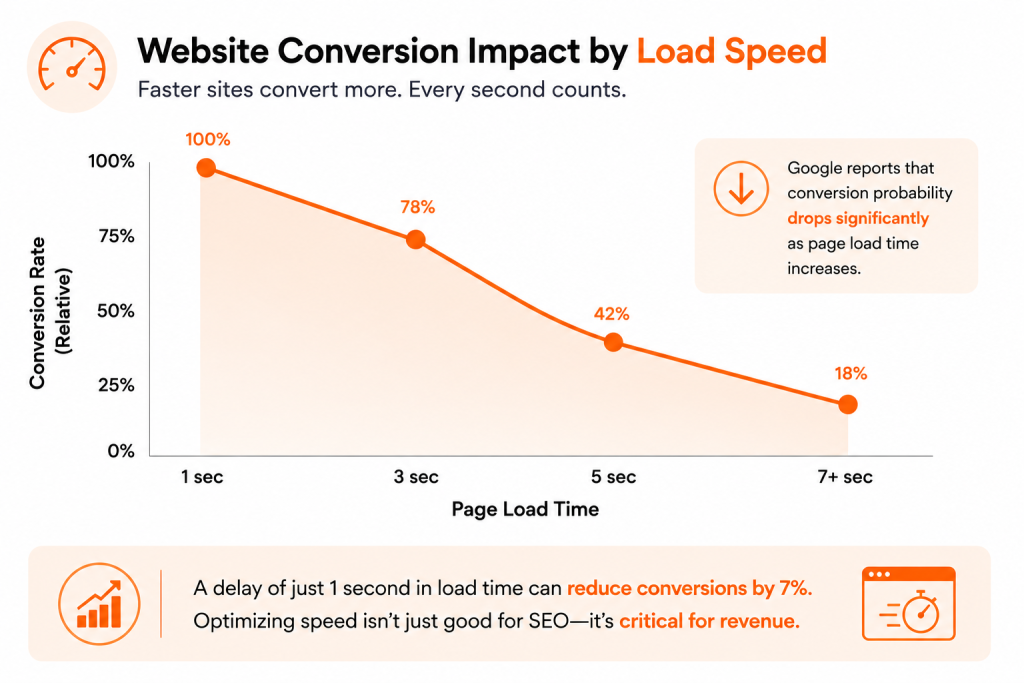
Technical SEO has become one of the most overlooked parts of ecommerce performance.
Many online stores suffer from problems such as:
- Slow loading pages
- Broken internal linking
- Duplicate category pages
- Poor mobile experiences
- Weak crawlability
- Thin product content
- Indexation issues
- Improper filtering systems
These issues can quietly damage rankings even when the website looks visually impressive.
This becomes even more important considering that most ecommerce traffic now comes from mobile devices. A slow or frustrating mobile experience directly impacts bounce rates, conversions, and rankings simultaneously.
Google increasingly prioritizes websites that provide fast, organized, and user friendly experiences.
That means technical SEO is no longer optional for ecommerce businesses trying to scale.
Category Pages Often Matter More Than Product Pages
One mistake many ecommerce brands make is focusing all SEO efforts on individual products.
In reality, category pages often drive far more scalable traffic.
| Product Pages | Category Pages |
|---|---|
| Lower keyword reach | Broader keyword coverage |
| Often thin content | Stronger topical authority |
| Harder to scale | Better internal linking |
| Limited search intent | Captures commercial intent |
| Lower traffic potential | Higher ranking scalability |
A well optimized category page targeting broader commercial intent searches can rank for dozens or even hundreds of related keyword variations simultaneously. Strong category pages also create better internal linking structures and improve overall topical authority.
For example, a category page targeting “industrial storage cabinets” can naturally support multiple related products while capturing broader search demand from users earlier in the buying process.
This is where ecommerce SEO becomes strategic rather than tactical.
The goal is not simply ranking a few products.
The goal is building an ecosystem of authority across the entire customer journey.
Content Is Becoming More Important in Ecommerce SEO
Many ecommerce brands underestimate how much content influences rankings today.
Educational articles, buying guides, FAQs, comparisons, and resource pages help Google understand expertise while also improving customer trust.
This is particularly important for higher consideration purchases where customers spend time researching before buying.
For example, someone purchasing industrial equipment, furniture, electronics, beauty products, or specialty supplies often searches multiple informational queries before making a decision.
Businesses that answer those questions effectively build authority earlier in the buying cycle.
This is one reason why ecommerce brands investing in long form SEO content often outperform competitors relying only on product listings.
Why Ecommerce SEO Is a Long Term Competitive Advantage
The strongest ecommerce brands view SEO as infrastructure rather than marketing. Advertising can generate immediate traffic, but SEO creates long term equity.
As rankings improve, authority strengthens, backlinks grow, and content expands, the website itself becomes a durable acquisition asset. That advantage compounds over time.
Especially in competitive ecommerce markets, the brands investing into SEO today are often creating visibility that becomes increasingly difficult for competitors to replicate later.
Final Thoughts on Hiring a Houston Ecommerce SEO Company
Ecommerce SEO has evolved dramatically. Today it requires technical expertise, conversion understanding, content strategy, user experience optimization, and deep understanding of search intent.
The businesses succeeding online are not simply optimizing pages for keywords. They are building websites designed around how customers actually search, research, compare, and purchase products. For ecommerce brands in Houston, that shift creates enormous opportunity.
Because while competition online continues growing, so does the value of organic visibility for businesses willing to invest in it properly.